
Reviewed · WAWEL CASTLE TOURS
Wawel Castle, Old Town with St. Mary’s Church Guided Tour
Wawel Castle is where Poland’s royal story comes alive, from Renaissance chambers and Flemish tapestries to the crypts beneath its Gothic cathedral. I like the way this tour joins the castle with St. Mary’s Basilica, so you see both royal power and Krakow’s everyday faith. I also like the 210-minute route, which gives you time for the key sights without turning the day into a museum marathon.
The main consideration is that your Wawel admission covers only one permanent exhibition, either the State Rooms, Royal Private Apartments, or Crown Treasury, depending on availability. With groups of up to 30 people, the experience is practical and efficient, but it will not feel like a private tour.
Key points at a glance
- Touch the Sigismund Bell: Climb Wawel Cathedral’s tower and take part in the local good-luck tradition.
- Choose one Wawel exhibition: Your ticket includes the State Rooms, Royal Private Apartments, or Crown Treasury, subject to availability.
- See the Veit Stoss altarpiece: St. Mary’s Basilica contains one of Krakow’s great works of Gothic art.
- Walk through royal and academic Krakow: The route links Wawel Hill, Collegium Maius, the Cloth Hall, and the Main Market Square.
- Use a licensed local guide: Tours are offered in English, French, German, Spanish, Italian, and Polish.
- Plan for church dress rules: Knees and shoulders must be covered at places of worship and selected museums.
Why this tour makes sense for a first visit to Krakow
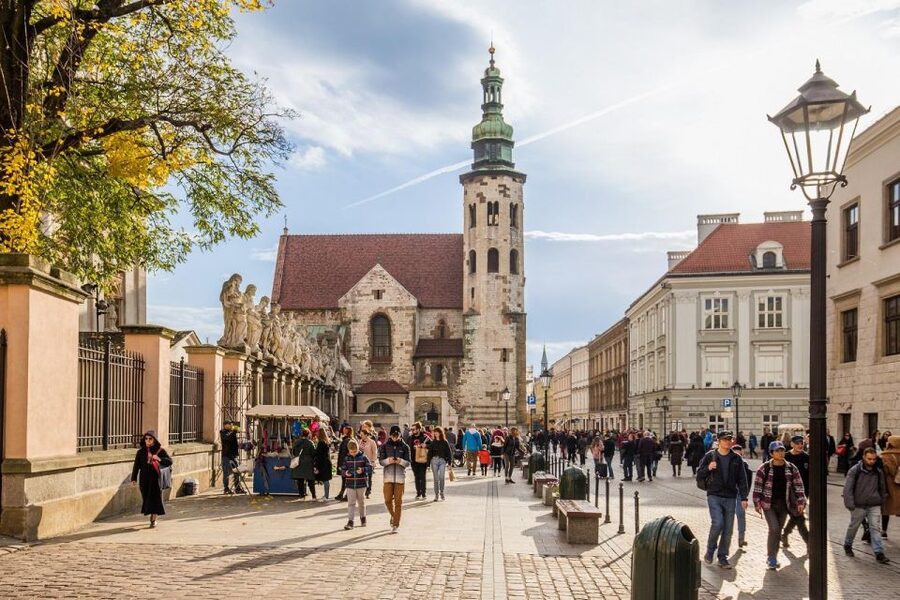
Krakow rewards wandering, but its major sights are easier to understand with a guide. Wawel Hill, the Old Town, and St. Mary’s Basilica are not just attractive stops on a sightseeing route. Together, they explain how Krakow grew as a royal capital, a religious center, and a place of learning.
I like this tour because it connects those pieces in one outing. You begin with Poland’s kings at Wawel Castle, move into the cathedral where monarchs were crowned and buried, then walk downhill into the Old Town. There, the focus shifts to university life, trade, and sacred art.
The price is $87 per person. That is not a bargain for a short city walk, but the value improves if you want admission arranged for you and prefer an expert to explain the complicated royal story. You receive entry to Wawel Cathedral, one permanent Wawel exhibition, and St. Mary’s Basilica, plus a guide for three and a half hours.
This works best for a first or second day in Krakow. You get the city’s major sights in one block of time, then can return later to the places that caught your attention. If you already know Wawel well or want to visit every castle room at your own pace, the limited exhibition access may feel restrictive.
More visits to St. Mary's Basilica in Krakow:
- Private Krakow Tour: St. Mary’s, Cloth Hall & More
★ 4.9 · 60 reviews - St. Mary’s Basilica and more – a short walk with a guide
★ 4.7 · 56 reviews - Wawel Castle, Cathedral, Old Town and St. Mary’s Basilica
★ 4.8 · 13 reviews
Meeting at St. Mary Magdalene Square
The tour begins at St. Mary Magdalene Square, by the Piotr Skarga Monument. Look for the guide holding an excursions.city sign. This detail matters because the meeting point is not on Wawel Hill, and arriving at the castle first could leave you scrambling to find the group.
Arrive at least 10 minutes early. Once the group leaves, latecomers cannot join, and the ticket cannot be refunded. That is a firm rule, so allow time to find the square and identify the monument.
The tour is conducted in one language, selected when you book. English, French, German, Spanish, Italian, and Polish are available. A group can include up to 30 people, the museum limit. That size keeps the tour manageable, though you should not expect the close attention of a private guide.
The guides bring strong local character to the route. One guide praised in the tour feedback is Jadwiga, who explained Krakow’s past with clear stories and made the castle and church easy to follow. Another guide was singled out for useful advice as well as solid explanations. Those details suggest that the guide can add value beyond pointing out rooms and monuments, especially when you ask for practical suggestions during the walk.
Inside Wawel Castle’s royal rooms
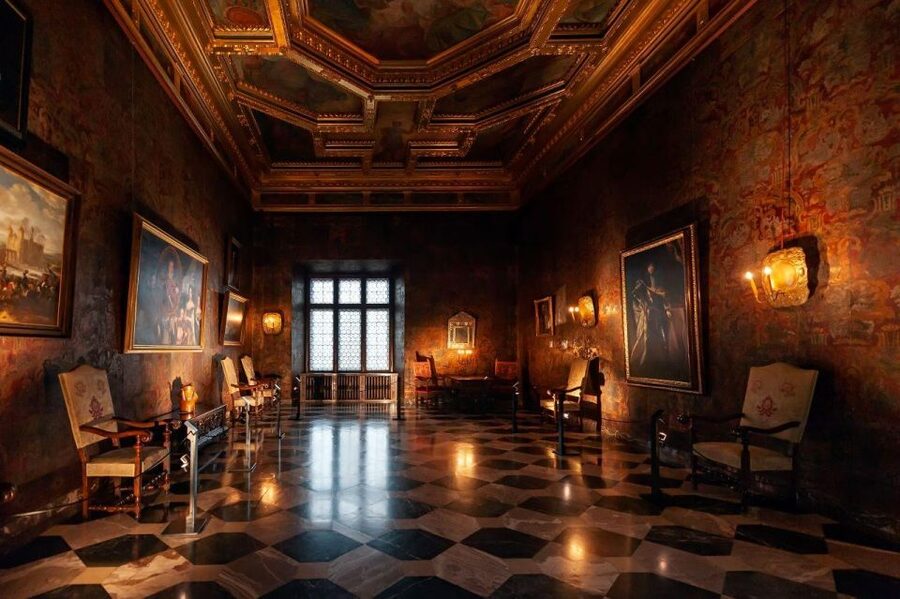
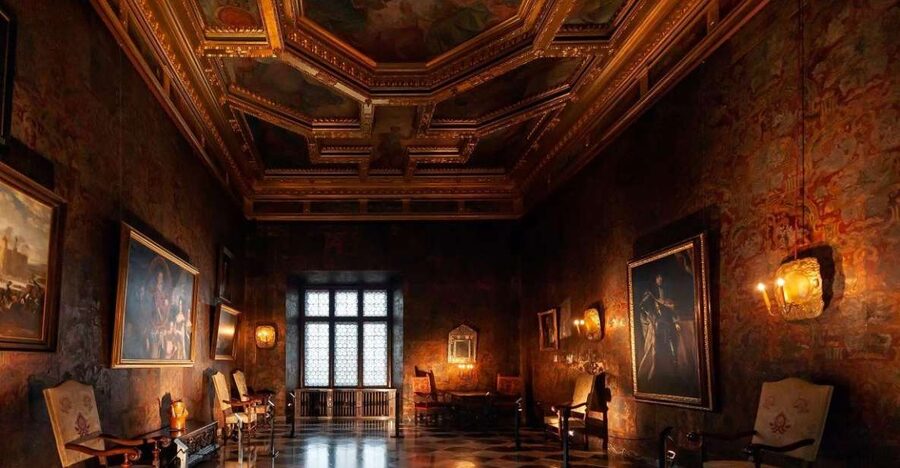
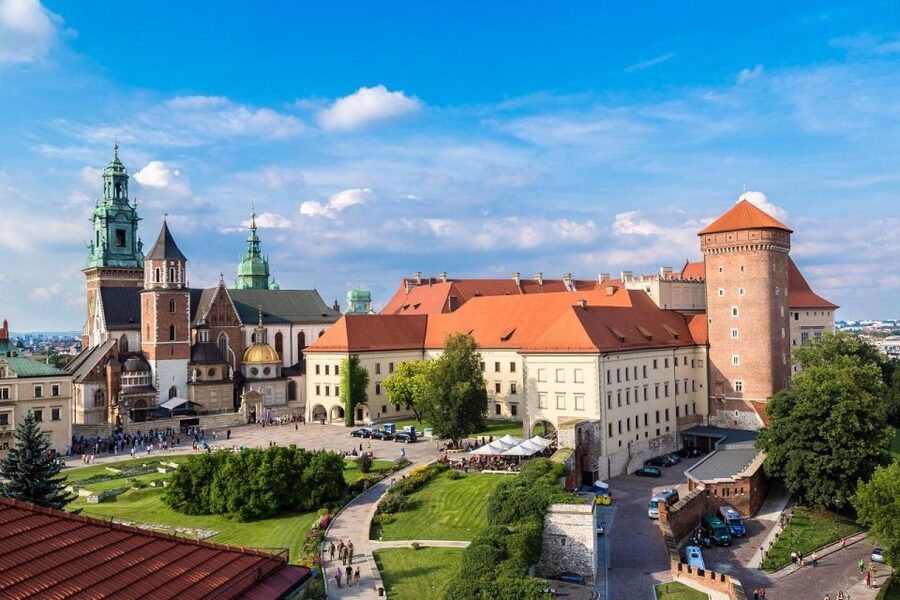
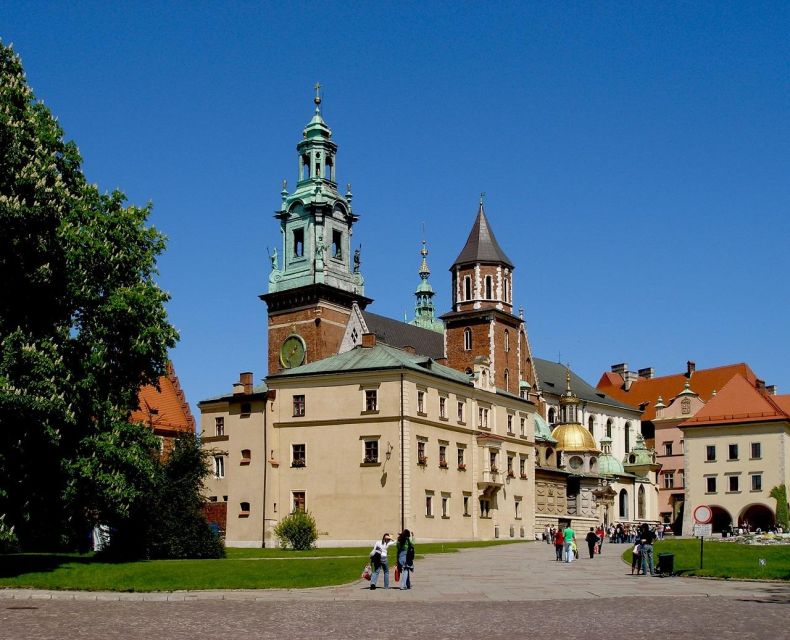
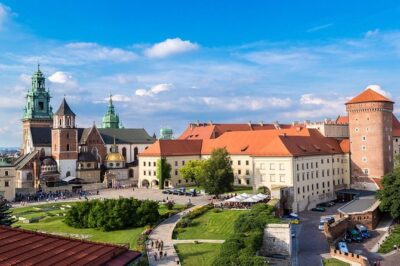
Wawel Castle sits on Wawel Hill above the Vistula River and served as the seat of Polish kings for centuries. It later became one of Poland’s major museums, with displays covering royal life, art, arms, decorative objects, and national identity.
Your ticket includes one permanent exhibition. Depending on availability, that may be the State Rooms, Royal Private Apartments, or Crown Treasury. This is the most important booking detail to understand. You are not receiving entry to every interior at Wawel, so ask your guide which section is included and adjust your expectations accordingly.
The State Rooms are the best choice if you want formal royal interiors. You can expect grand rooms shaped by Renaissance and Baroque design, with paintings, furnishings, porcelain, and decorative details that show how the court presented itself.
The Royal Private Apartments offer a more personal angle on monarchy. Instead of only seeing ceremonial spaces, you get a sense of where members of the royal household lived and worked. The Crown Treasury focuses on objects linked to royal authority and ceremony.
The castle collection also includes Flemish tapestries commissioned by King Sigismund II Augustus. These large woven works are more than wall decoration. They show the scale, cost, and artistic ambition of the royal court, and they help you picture how the rooms once looked when the castle served as a working seat of power.
You may also see Italian Renaissance pieces from the Lanckoroński collection, military artifacts, sculptures, and porcelain. Wawel’s Eastern art collection adds another layer, including the largest set of Ottoman tents in Europe. That material is useful because it widens the story beyond Poland’s immediate borders. Royal Krakow was connected to trade, diplomacy, warfare, and artistic exchange across Europe and beyond.
A guide is particularly helpful here. Without context, a tapestry or ceremonial object can become another beautiful thing behind glass. With a clear explanation, you begin to see how art, religion, and political authority worked together.
Wawel Cathedral, the Sigismund Bell, and the crypts
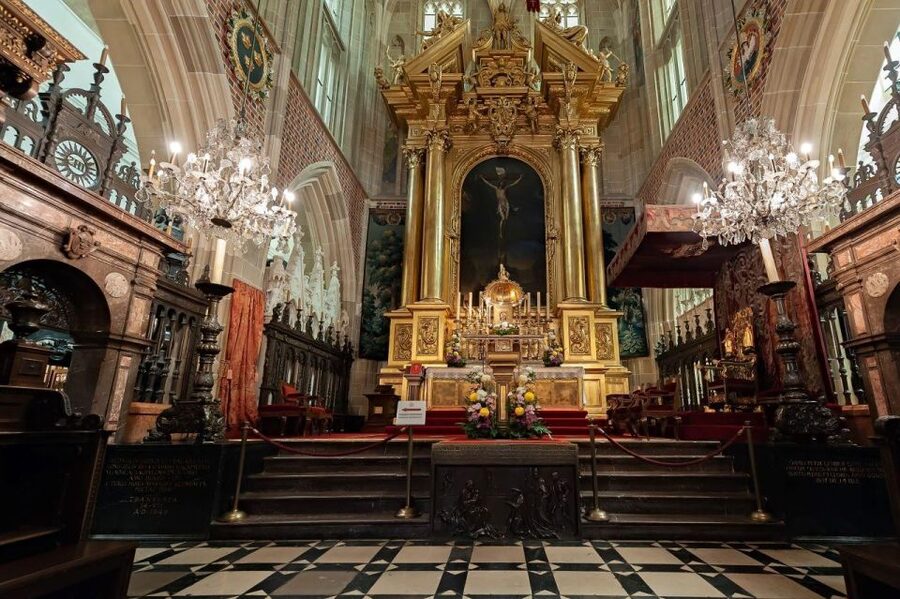
Wawel Cathedral is a Gothic church with a role that reaches well beyond its architecture. Polish monarchs were crowned here, and royal weddings and funerals took place within its walls. The cathedral remains one of the clearest places to understand the connection between Polish national identity and Catholic tradition.
Inside, your guide leads you through chapels, altars, and memorial spaces. The details can feel dense, so listen for the stories that connect the building to specific rulers, ceremonies, and national figures. This is a place where a short explanation can prevent the visit from becoming a blur of names.
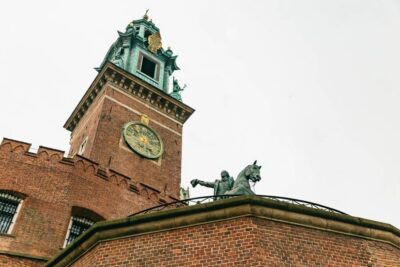
The tower climb leads to the Sigismund Bell. Tradition says that touching it brings good luck. It is a small, human moment in a tour filled with kings and national heroes, and it gives you something active to do rather than simply look at another monument.
The tower requires climbing, so comfortable shoes matter. The tour information does not promise any special assistance for the climb, so consider your own comfort before booking. The cathedral and castle also involve walking between sites, and Krakow’s weather can change quickly.
Below the cathedral, the crypts contain the remains of kings, queens, poets, and national heroes. Your guide explains how power, faith, and public memory meet in this underground space. The crypts are not just a list of burials. They show which figures Poland chose to honor and how the cathedral became a place of national remembrance.
Dress carefully for this part of the tour. Shorts and sleeveless tops are not allowed in places of worship and selected museums. Both men and women must cover their knees and shoulders. A light layer and modest clothing will save you from an awkward problem at the entrance.
More Wawel Castle tours in Krakow:
- Krakow: Wawel Castle & Cathedral Guided Tour
★ 4.7 · 2,111 reviews - Old Town Krakow & Wawel Castle Walking Tour
★ 5.0 · 1,508 reviews - Krakow: Wawel Royal Hill with Optional Castle and Cathedral
★ 4.2 · 1,220 reviews - Krakow: Wawel Castle and Cathedral Guided Tour
★ 4.6 · 595 reviews
Collegium Maius and Krakow’s life of learning
After Wawel, the route continues through the historic center to Collegium Maius, the oldest building of the Jagiellonian University. The university was founded in 1364 and educated generations of scholars, including Nicolaus Copernicus.
The courtyard is a quieter stop than the Main Market Square. I like that change in pace. Your guide explains how the university helped make Krakow an important center of learning in Central Europe and why it still matters to the city today.
This is also a good place to connect the city’s royal story with its intellectual life. Kings and churches dominate much of the Wawel visit, but Collegium Maius reminds you that Krakow’s identity was also shaped by teachers, students, scientists, and books.
The tour may not include a full interior visit to every university room, so treat this stop as a guided look at the building and its place in Krakow rather than a separate museum visit. The value comes from the context and the setting.
The Main Market Square and the Cloth Hall
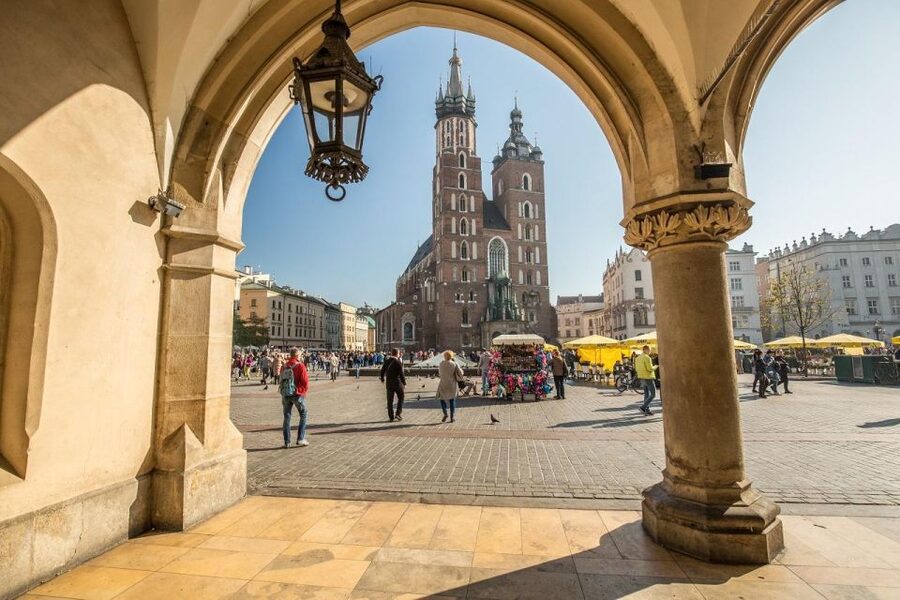
A few steps farther, you reach Krakow’s Main Market Square, the largest medieval square in Europe. It is the city’s great public room, framed by townhouses and filled with activity.
You may see horse-drawn carriages, street performers, and the steady movement of people crossing the square. The space can feel busy, especially at popular times, so stay close to the guide and keep track of the meeting rhythm.
The Cloth Hall, or Sukiennice, occupies the center. Its Renaissance arcade recalls the building’s long role as a marketplace for international trade. Merchants once dealt in salt, textiles, furs, and amber here, linking Krakow with distant markets.
I appreciate this stop because it makes the city’s wealth easier to understand. Wawel shows royal power, while the Cloth Hall shows commerce. The square also gives you a useful orientation point for later independent walks. After the tour, you can return to explore the arcades and surrounding streets at your own pace, although this tour focuses on the exterior story and the city setting rather than promising a separate shopping visit.
St. Mary’s Basilica and the Veit Stoss altarpiece
The final major stop is St. Mary’s Basilica, whose two uneven towers are among Krakow’s most familiar sights. The asymmetry is easy to notice from the square, but the interior is the real reason this church belongs on the route.
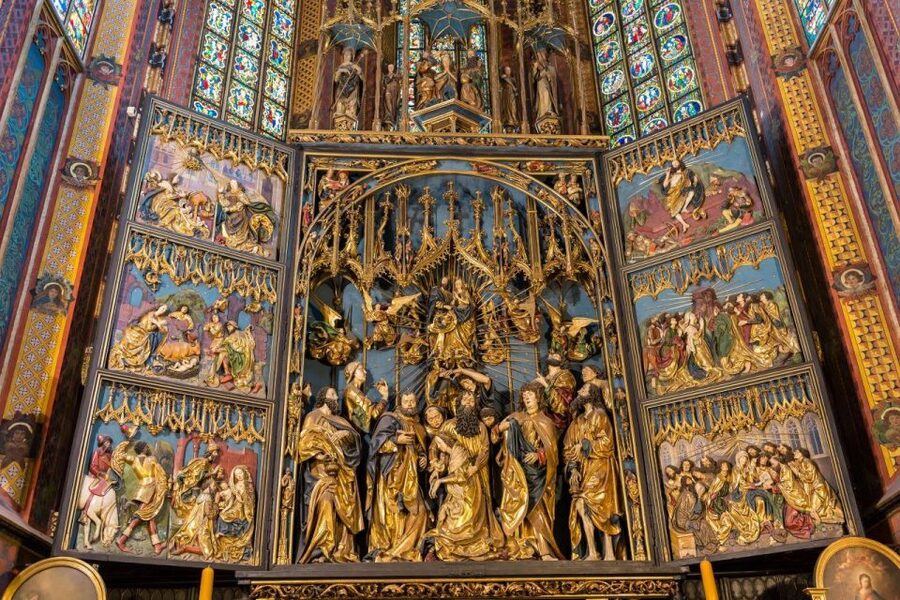
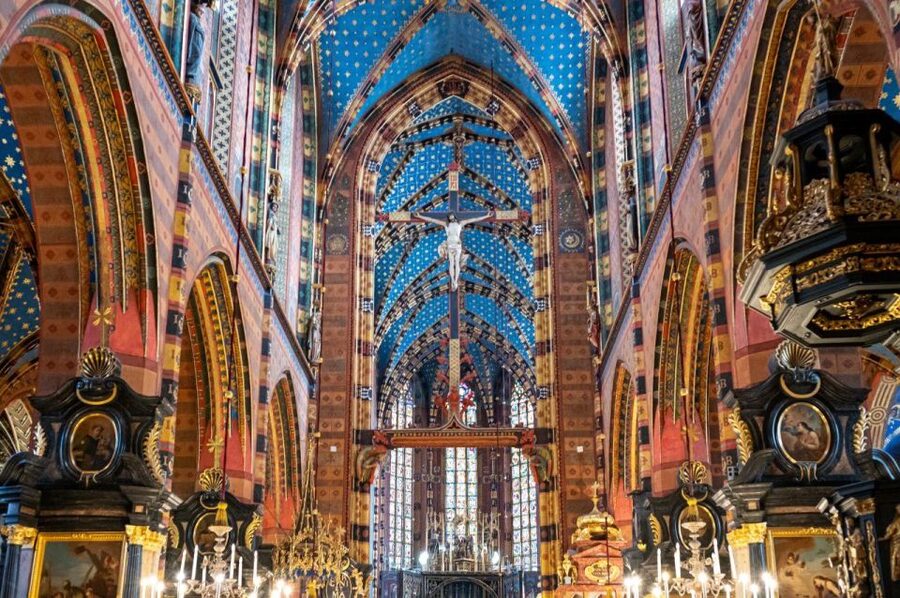
Inside, you see the Veit Stoss altarpiece, carved in the 15th century. Its large figures, dramatic biblical scenes, strong color, and fine detail make it one of the great works of Gothic Europe. The scale is impressive, but the small carved details reward a slower look.
Your guide explains how the altarpiece survived fires, war, and other periods of upheaval. That background gives the work more weight. You are not just seeing an old church furnishing. You are seeing an object that remained important through centuries of danger and change.
Look up at the painted vaults and stained glass, then give yourself time to take in the chapels. The church is still a place of worship, so the atmosphere can shift with services and religious activity. The group needs to follow the guide’s instructions and respect the setting.
Admission to St. Mary’s Basilica is included, which adds useful value to the tour. You could see the exterior on your own, but the interior works better when someone points out the altarpiece and explains why it matters.
Timing, group size, and walking demands
The tour lasts 210 minutes, or three and a half hours. That is long enough to cover the main sites without requiring a full day devoted only to guided sightseeing.
You should expect a walking-heavy experience. The route includes Wawel Hill, interior museum spaces, the cathedral tower, the crypts, Collegium Maius, the Main Market Square, and St. Mary’s Basilica. Wear comfortable shoes and prepare for changing weather because the tour runs in all conditions.
A maximum of 30 participants is not tiny, but it is controlled by the museum’s limits. The guide may use a meeting system or ask the group to stay together, especially in crowded parts of the Old Town. If you prefer to stop often for photographs, you may need to wait for the planned pauses rather than wander ahead.
The pace appears suited to people who want a clear overview. It may feel brisk if you want long periods inside each room, especially since only one Wawel permanent exhibition is included. The advantage is that you see several major Krakow sights in one morning or afternoon.
Who should book this Wawel and Old Town tour
I would recommend this tour to first-time visitors who want a guided introduction to Krakow’s key sights. It is especially useful if you want to understand how the castle, cathedral, university, market, and basilica fit together rather than visiting them as unrelated stops.
It also suits you if you prefer having entrance tickets organized in advance. The skip-the-line entry can save time at the included Wawel exhibition, cathedral, and basilica, though it does not turn the tour into a private visit.
You will get the most from it if you enjoy stories about rulers, religion, art, and civic life. The guide’s role is central, and the positive feedback points to clear explanations, useful advice, and engaging anecdotes. Jadwiga, in particular, received praise for making Krakow’s past easy to follow.
I would hesitate if you want extensive free time at Wawel or hope to visit every permanent and temporary exhibition. The tour excludes exhibitions beyond the listed one. Food and drinks are not included either, so plan a meal before or after the outing.
You should also think about the church dress code and tower climb. These are easy to manage with suitable clothing and shoes, but they are worth knowing before you arrive.
Is the $87 price fair?
At $87, the tour is priced for convenience, admission, and guided interpretation rather than for a simple walk around the Old Town. The strongest value comes from the combination of Wawel access and St. Mary’s Basilica. You avoid arranging several tickets yourself and get the larger story explained as you move through the city.
The value is less clear if you only want exterior photographs. You can see the Main Market Square, Cloth Hall, Collegium Maius, and much of Wawel Hill independently. The paid experience earns its price through the interiors, cathedral access, exhibition entry, and guide.
Reserve now and pay later is available, and you can cancel up to 24 hours before the start for a full refund. Those terms help if your Krakow plans are still shifting. Just remember that missing the meeting time is different from canceling in advance. Late arrivals cannot join and do not receive a refund.
Should you book it?
Book this Wawel Castle, Old Town, and St. Mary’s Church tour if you want a well-packed first look at Krakow’s royal, religious, academic, and commercial heart. The Sigismund Bell, the cathedral crypts, the Flemish tapestries, Collegium Maius, and the Veit Stoss altarpiece give the three and a half hours plenty of substance.
Before booking, confirm that you are comfortable with a group of up to 30, a walking-focused route, and entry to only one Wawel permanent exhibition. If those limits suit you, the $87 price is reasonable for the amount of admission and explanation included. Wear modest clothing, arrive early at St. Mary Magdalene Square, and let the guide handle the complicated parts of Krakow’s past.
FAQ
Where does the tour meet?
Meet your guide at St. Mary Magdalene Square by the Piotr Skarga Monument. The guide will hold an excursions.city sign, and the meeting point is not on Wawel Hill.
How long does the tour last?
The tour lasts 210 minutes, or three and a half hours.
Which Wawel Castle exhibition is included?
Your ticket includes one permanent exhibition: the State Rooms, Royal Private Apartments, or Crown Treasury. The specific exhibition depends on availability.
Is entry to Wawel Cathedral included?
Yes. The tour includes a ticket to Wawel Cathedral, including the cathedral visit described in the itinerary.
Is St. Mary’s Basilica included?
Yes. Entry to St. Mary’s Basilica is included, including the chance to see the Veit Stoss altarpiece.
Which languages are available?
The tour is available in English, French, German, Spanish, Italian, and Polish. Each group uses one language selected at booking.
What should I wear?
Places of worship and selected museums require covered knees and shoulders. Shorts and sleeveless tops are not allowed, and comfortable walking shoes are recommended.
More Old Town walking tours in Krakow
- Krakow: Bike Tour of Old Town, Jewish Quarter and the Ghetto
★ 4.9 · 1,155 reviews - Krakow: The Old Town Walking Tour
★ 4.8 · 794 reviews - Krakow: Old Town Guided Segway Tour
★ 4.7 · 756 reviews - Kraków: Old Town & Wawel Castle Walking Tour in English
★ 4.8 · 532 reviews
Just added around Krakow
- From Krakow: Zakopane Full-Day Tour with Lunch Option★ 4.4 · 62 reviews
- From Krakow: Zalipie and Painted Village Guided Tour★ 4.0 · 4 reviews
- From Krakow: Zakopane and Dunajec River Rafting Tour★ 4.6 · 31 reviews
- From Krakow: Zakopane and the Tatra Mountains★ 4.7 · 36 reviews
- From Krakow: Zakopane and Gubałówka Cable Car Private Tour★ 4.3 · 12 reviews
- From Krakow: Zakopane Tatra Mountains & Hot Springs Tour★ 3.0 · 29 reviews
- Zakopane & Tatra Mountains Private Full-Day Tour from Krakow★ 4.5 · 33 reviews
- From Krakow: Hot Springs and Zakopane with Gubałówka★ 4.7 · 25 reviews
Wawel Castle Tours, compared.
Wawel Royal Hill with Optional Castle and Cathedral
Read our review →
Old Town & Wawel Castle Walking Tour in English
Read our review →
Krakow’s Essential Tour of the Old Town and Wawel Castle
Read our review →Browse the lists this tour appears in