
Reviewed · KRAKOW OLD TOWN WALKING TOURS
Katowice Old Town Walking Tour
Katowice’s story is not a simple Polish old-town tale. It is a Silesian story of shifting borders, mixed Catholic and Protestant influences, industrial ambition, wartime resistance, and modern city life. This private walk brings those threads together, from the old Market Square to the giant flying-saucer shape of Spodek.
I like the clear focus on Silesian identity, and I like the route’s mix of grand public buildings, churches, shopping streets, monuments, and ordinary city corners. Guide Malwina has a strong grasp of the region’s changing ties between Slavic and German cultures, which gives the walk more substance than a quick list of buildings.
The main consideration is distance. You walk about 6.5 kilometers in three hours, so comfortable shoes and a moderate level of fitness matter. Also check the meeting point carefully: the route is in Katowice, although the location field names Krakow.
Key points to know before you book
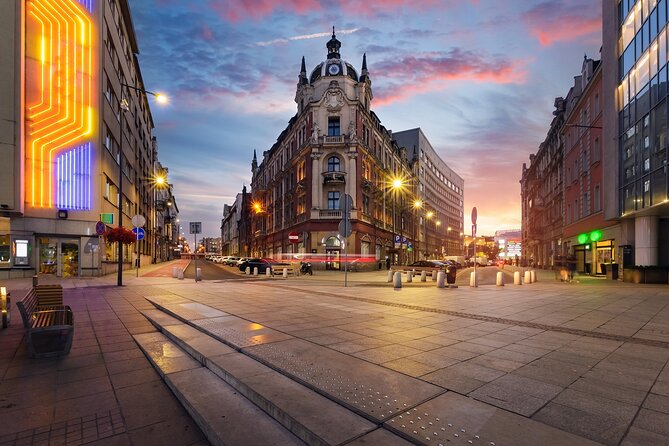
- Katowice, not Krakow: Meet at the Silesian Theatre, Rynek 10, in Katowice.
- A private walk with Malwina: Your group receives the guide’s full attention, with the tour offered in English.
- Silesian culture takes center stage: The route explains the region’s Polish, German, Catholic, Protestant, political, and industrial influences.
- A 6.5-kilometer route: The walk covers a lot of ground, including Market Square, Stawowa, the Silesian Insurgents’ Monument, and Spodek.
- Mostly exterior sightseeing: All listed stops are free, but the tour does not promise paid interior admissions or extended visits inside.
- A strong first look at Katowice: You get old streets, nineteenth-century tenements, modern event spaces, major monuments, and the city’s best-known symbol in one outing.
Why this walk explains Katowice better than a simple old-town stroll
Katowice can surprise you. It is not only a preserved medieval center with one grand square and a line of postcard buildings. The city’s identity grew through industry, regional politics, migration, changing borders, music, religion, and twentieth-century rebuilding.
That is why this route works best as a city introduction. You are not simply looking at façades. You are moving through different layers of Silesian life. One stop points toward communist-era shopping culture. Another shows religious differences in the region. A monument recalls resistance to the Nazis. Spodek brings you into modern Katowice.
I would choose this tour early in a stay if I wanted a framework for the city. The route gives you names, buildings, and historical subjects that make later wandering more rewarding. It also helps explain why Katowice can feel different from other Polish cities.
The tour is private, so the experience can feel more personal than a large group walk. If you are the only person booked, you get individual attention from Malwina and can ask questions throughout. That format is particularly useful here because Silesian identity has several layers, and a good explanation matters more than a rapid procession of sights.
More Old Town walking tours in Krakow:
- Old Town Krakow & Wawel Castle Walking Tour
★ 5.0 · 1,508 reviews - Krakow: Bike Tour of Old Town, Jewish Quarter and the Ghetto
★ 4.9 · 1,155 reviews - Krakow: The Old Town Walking Tour
★ 4.8 · 794 reviews
Starting at the Silesian Theatre and Market Square
The meeting point is the Silesian Theatre at Rynek 10. This gives you a central place to begin and puts the city’s public life in view from the first minute.
The opening section covers Market Square, the Silesian Theatre, and the Skarbek and Zenit buildings. Skarbek and Zenit are tied to the shopping culture of communist Poland, when these large commercial buildings represented a very different idea of a shopping center from the polished retail spaces you see today.
That detail gives the opening real character. You are looking at buildings that help explain everyday life under communism, not just older architecture. The route also points out some of Katowice’s oldest buildings, so the first stop sets up a useful contrast between older urban fabric and later commercial development.
You have about 15 minutes here. That is enough for an orientation and an explanation, but not enough for a long architectural study. If you want extensive interior visits or time to browse shops, you will need to return on your own.
The route also passes through a local area associated with eating, drinking, and nightlife. The exact stop is not named, but its role is clear: you see where Silesians go out today, not only where the city’s official monuments are located.
That balance matters. A city tour can become too focused on political buildings and memorials. This section adds the ordinary pleasures of urban life and gives you a feel for how Katowice is used after work and after dark.
The Mariacki Church and Katowice’s religious contrasts
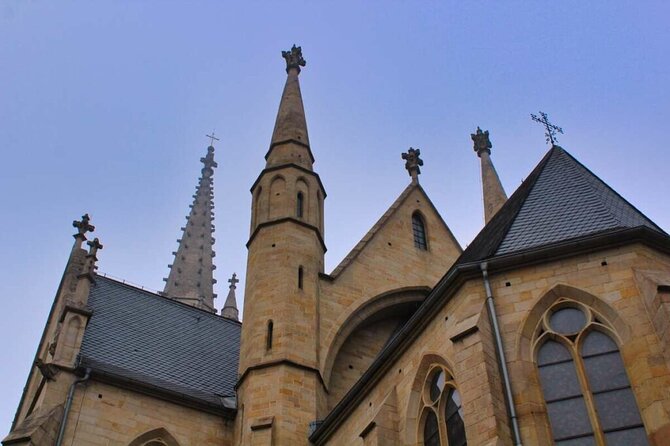
The Immaculate Conception Catholic Church, also called Kosciol Mariacki, is scheduled for about 10 minutes. The building is presented as an architectural highlight from the outside, with works by leading Polish artists inside.
The short timing suggests that this is mainly a focused stop rather than a long church visit. You can expect an explanation of the exterior and an opportunity to see the interior artworks, provided access is available at the time of the walk.
Churches are especially useful in Katowice because religion here connects with the wider question of Silesian identity. The route later contrasts Catholic and Protestant visual character at the Cathedral of Christ the King. Together, the two stops help you see that Silesia is not culturally one-note.
Be respectful inside. A church is still a working place of worship, and access can depend on services or local conditions. The tour description includes no admission charge for this stop.
Music, public power, and an informal theater
The Academy of Music in Katowice receives about seven minutes. It is described as Poland’s most prestigious music academy, making it an important cultural institution rather than just another handsome building.
This brief stop is valuable because it widens the picture of Katowice. The city is often reduced to coal, factories, and postindustrial change. Music is part of its public identity too, and the academy points to the serious artistic life behind that stereotype.
Next comes the Silesian Parliament, the former seat of the parliament of the Autonomous Silesia Region. This is one of the route’s most important political stops. It gives you a chance to consider Silesia as a region with its own political character and a history of negotiating its place within larger states.
The tour also includes a local theater known for an informal atmosphere. Its name is not specified, so do not book expecting a particular theater interior or performance. Think of it as a quick look at a place where local culture feels less formal and more connected to everyday city life.
These stops work well together. The academy represents music, the parliament represents regional government, and the theater represents accessible culture. In a short stretch, you see three ways Katowice expresses itself beyond monuments and shopping streets.
More Katowice tours and transfers in Krakow:
- Private One-Way Transfer from Kraków to Katowice Airport
★ 5.0 · 157 reviews - Auschwitz – Birkenau from Katowice
★ 4.5 · 37 reviews - Katowice Airport Krakow Private Transfer, Private Driver Service
★ 5.0 · 7 reviews - Private Tour to Auschwitz & Birkenau from Katowice
★ 4.5 · 6 reviews
Cathedral of Christ the King and mixed Silesian identity
The Cathedral of Christ the King is another 10-minute stop. Its exterior reads as strongly Catholic, while the interior is described as more Protestant in character.
That contrast is one of the tour’s most useful ideas. Silesia has changed hands and cultural direction over time, and its religious buildings can show those mixed influences in ways a timeline cannot. You do not need to be a specialist in church architecture to notice the difference once the guide points it out.
The cathedral also gives the tour a moment of quiet reflection. Much of the route concerns public power, shopping, streets, monuments, and city symbols. Here the focus shifts to spirituality and the varied origins of the region.
Again, the visit is short. You should expect interpretation and a look inside rather than a full architectural lecture. If religious art is a main interest, you may wish to return later with more time.
Walking through Miarka Square, Dworcowa, 3 Maja, and Stawowa
The longest section of the tour is the 30-minute walk through Miarka Square, Dworcowa Street, 3 Maja Street, and Stawowa. This is where the city becomes most readable at street level.
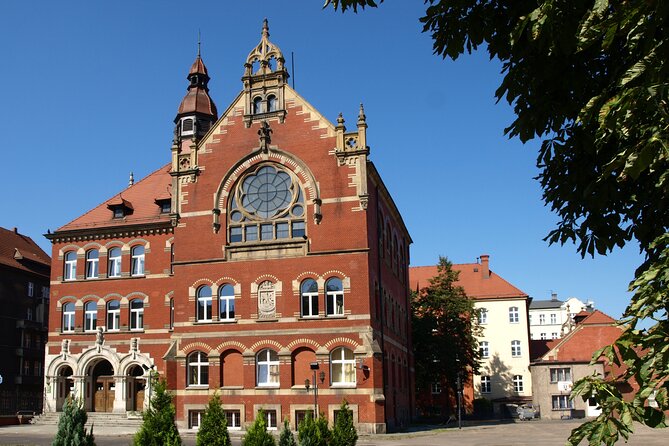
You will see nineteenth-century tenement buildings and pass the oldest high school in Katowice. Those details matter because they show how the city grew as an urban center. A square or monument tells you what a city wants to remember. Tenements and schools tell you how it expanded and how people lived within it.
Stawowa is also a useful change of pace. Instead of stopping at one major building, you move through a sequence of streets. That lets you compare façades, street widths, commercial activity, and the feel of different parts of the center.
This section may be the most rewarding for anyone who likes architecture but does not want an old-town walk limited to famous landmarks. It also gives Malwina room to explain how Katowice developed, rather than delivering only short facts at fixed stops.
The route includes a monument commemorating Silesian scouts who opposed the Nazis in 1939. It is a smaller memorial subject than the main Insurgents’ Monument, but it adds a personal and local angle to wartime history. You are reminded that resistance was not only the work of famous military leaders or politicians.
You also pass a venue used for art exhibitions, international meetups, and other events. The name is not provided, but the stop helps connect the historic center with present-day cultural life.
The Silesian Insurgents’ Monument and three uprisings
The Silesian Insurgents’ Monument is one of the route’s central historical stops. It commemorates three Silesian uprisings, giving you a direct link to the region’s struggles over political belonging and national identity.
This is the point where earlier parts of the walk come together. The discussion of Polish and German connections, regional government, and Silesia’s shifting place in Europe becomes concrete. The monument is not simply decorative city art. It represents conflict over who would govern and define the region.
You have about 10 minutes here. That is enough to understand the monument’s subject and significance, though anyone interested in the uprisings in detail will need a separate museum visit or further reading.
I like the placement in the route. By this point, you have already seen ordinary streets, churches, cultural institutions, and government buildings. The monument then gives those surroundings a sharper political meaning.
Finishing at Spodek, Katowice’s famous city symbol
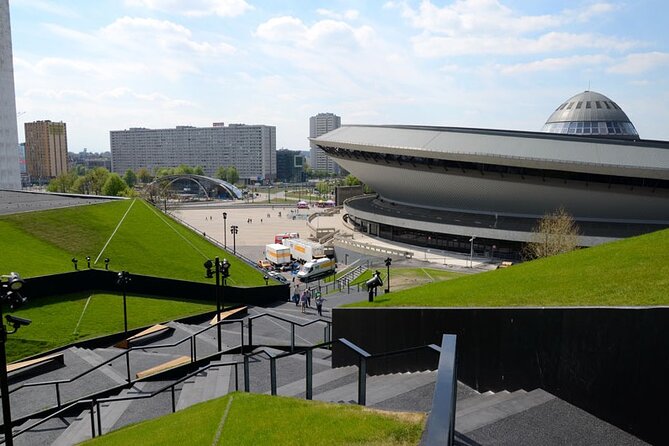
The final major stop is Spodek, with about 10 minutes set aside for it. The name means saucer, and the building’s unusual form has become the symbol of Katowice.
Spodek changes the mood again. After old tenements, churches, parliament, and war memorials, you finish with a modern structure associated with the city’s public image. It is a good closing point because Katowice is not only a city looking backward. Its identity also includes large cultural and event spaces.
The tour ends back at the Silesian Theatre meeting point. Since the route covers a wide part of central Katowice, you finish with a stronger sense of how the city’s sections relate to one another.
Do not expect a ticketed event at Spodek. The stop is for viewing and explanation, and admission is listed as free.
What the $81.62 price means
At $81.62 per person, this is not the cheapest way to see Katowice. The value depends heavily on group size. Since it is a private activity, the price buys personal attention rather than a seat in a large walking group.
For a solo visitor, the cost is easier to justify if you want questions answered and a flexible conversation with the guide. The same price may feel better shared among several people because group discounts are available. If you are traveling with family or friends, check how the discount affects the total before deciding.
You are paying mainly for the guide’s interpretation, not entrance tickets. The listed stops are free, and the route does not include a major paid attraction. That makes the guide especially important. Malwina’s background in Silesian history and culture is a central part of the tour’s value.
I would not book this solely to collect photo stops. I would book it if I wanted to understand why Katowice looks and feels the way it does. The walk connects buildings that might otherwise seem unrelated.
Distance, weather, and practical planning
Plan on three hours and roughly 6.5 kilometers of walking. That is a moderate physical commitment, especially if you have already spent the morning on your feet. Wear comfortable shoes and bring water.
The experience requires good weather. If poor weather causes cancellation, you are offered another date or a full refund. The tour also requires a minimum number of participants, despite being private for your group, so a cancellation is possible if that minimum is not reached.
The activity is offered in English and includes a mobile ticket. Service animals are allowed, and the meeting point is near public transportation. The information provided does not specify wheelchair access, child pricing, restroom breaks, or interior access at every building, so ask before booking if any of those details affect your plans.
Free cancellation is available up to 24 hours before the start time. Cancellations made less than 24 hours before the start are not refunded, and changes inside that period are not accepted.
Who should book this Katowice walk?
I would recommend it to first-time visitors who want a strong introduction to Katowice, especially anyone interested in regional identity, architecture, politics, religion, and twentieth-century history.
It also suits solo visitors. A private format gives you space to ask about the points that catch your attention, and Malwina can give the walk a more personal rhythm.
This is a good choice for friends or families who want to stay together instead of joining a large group. Group discounts may improve the price, and the route includes enough variety to keep the walk from feeling like a long architecture lecture.
I would think twice if you want extensive indoor sightseeing, a slow photography walk, or a short route. The schedule is active, many stops are brief, and the distance is substantial.
Should you book it?
Book this tour if you want Katowice explained as a Silesian city, not just photographed as a collection of buildings. The strongest parts are the private format, Malwina’s clear grasp of the region’s shifting Polish and German influences, and the route’s range from communist-era shopping landmarks to churches, political memorials, old tenements, and Spodek.
Skip it if you mainly want paid museum entries or a quick stroll around one compact square. For everyone else, this is a useful first look at a city that rewards context.
FAQ
Where does the Katowice Old Town Walking Tour begin?
It begins at the Silesian Theatre, Rynek 10, 40-003 Katowice, Poland.
Where does the tour end?
The activity ends back at the Silesian Theatre meeting point.
Is the tour in Krakow or Katowice?
The route and meeting point are in Katowice. The location information also refers to Krakow, so confirm the city carefully before booking and traveling to the start.
How long is the walking tour?
The tour lasts approximately three hours.
How far do you walk?
You walk about 6.5 kilometers during the tour.
Is the tour private?
Yes. Only your group participates in the activity.
What language is offered?
The tour is offered in English.
Are admission tickets included?
The listed stops have free admission. The experience does not list paid entrance tickets to additional attractions.
Are service animals allowed?
Yes, service animals are allowed.
What happens if the weather is poor?
If the tour is canceled because of poor weather, you are offered a different date or a full refund.
Can I cancel for a full refund?
Yes. You must cancel at least 24 hours before the experience start time for a full refund.
Just added around Krakow
- From Krakow: Zakopane and Dunajec River Rafting Tour★ 4.6 · 31 reviews
- From Krakow: Zakopane Full-Day Tour with Lunch Option★ 4.4 · 62 reviews
- From Krakow: Zalipie and Painted Village Guided Tour★ 4.0 · 4 reviews
- From Krakow: Zakopane and the Tatra Mountains★ 4.7 · 36 reviews
- From Krakow: Zakopane and Gubałówka Cable Car Private Tour★ 4.3 · 12 reviews
- From Krakow: Zakopane Tatra Mountains & Hot Springs Tour★ 3.0 · 29 reviews
- Zakopane & Tatra Mountains Private Full-Day Tour from Krakow★ 4.5 · 33 reviews
- From Krakow: Hot Springs and Zakopane with Gubałówka★ 4.7 · 25 reviews
Krakow Old Town Walking Tours, compared.
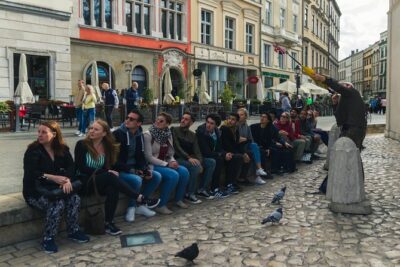
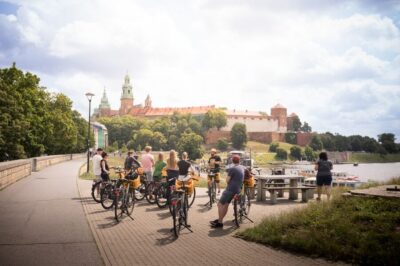
Bike Tour of Old Town, Jewish Quarter and the Ghetto
Read our review →

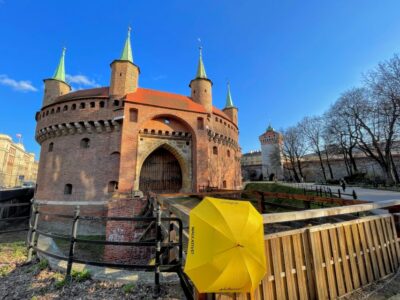
Old Town & Wawel Castle Walking Tour in English
Read our review →
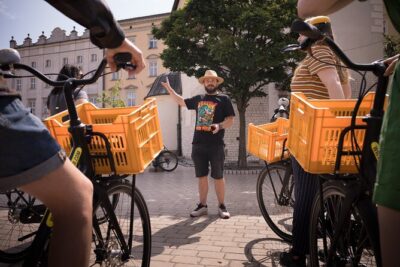
Full Bike Tour – the Old Town, Jewish Qtr & the Ghetto NEW BIKES
Read our review →
Krakow Old Town Segway Tour 2hr with Training, Safety Gear, Guide
Read our review →Browse the lists this tour appears in