
Reviewed · KRAKOW JEWISH GHETTO TOURS
Full Bike Tour – the Old Town, Jewish Qtr & the Ghetto NEW BIKES
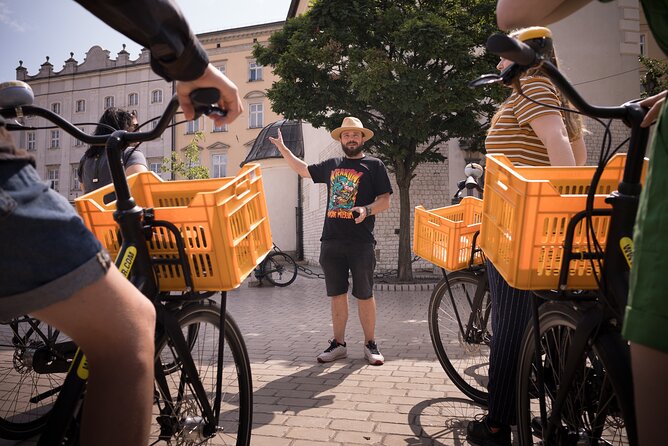
Krakow’s best sights spread beyond the Old Town, and this mostly flat bike route links them neatly. In three to four hours, you ride from the medieval center to Wawel, Kazimierz, the former Jewish Ghetto, and Schindler’s factory, with local stories along the way. It is a fine way to get your bearings early in a visit.
I like the easy pace and the chance to use bike lanes and car-free stretches that are awkward to cover on foot. I also like the guides’ personal approach. Chris, Thomas, Alex, and Krzysztof are singled out for clear storytelling, good humor, and strong knowledge of Krakow’s past. The main drawback is that a stop can feel brief when you want photographs, and one comment raised concerns about bike quality, though most riders found the bikes comfortable and well maintained.
Key points to know before booking
- A wide city route: You cover the Old Town, Wawel Hill, Kazimierz, the former Jewish Ghetto, Planty Park, and the medieval gates.
- Mostly flat cycling: The route is designed for sightseeing, not athletic training, and takes about three to four hours.
- Local guides matter: Chris, Thomas, Alex, Mike, and Krzysztof have led tours praised for engaging stories and useful Krakow advice.
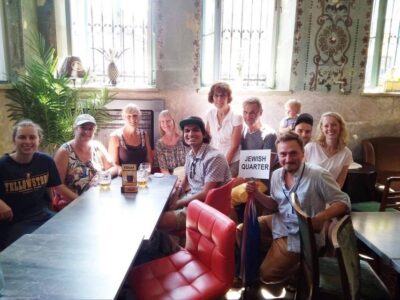
- Small group size: The maximum is 15 people, which leaves room for questions without making the tour feel fully private.
- Good first-day choice: The ride gives you a quick sense of the city’s layout and helps you decide where to return later.
- A few limits: Food, drinks, and entry to Wawel Castle, Schindler’s Factory, and the Barbican are not included.
Why a bike is a smart way to see Krakow
Krakow’s historic center is compact, but the full story does not fit inside the Old Town walls. A walking tour can cover the Main Market Square and Wawel, yet reaching Kazimierz, Plac Bohaterów Getta, and Schindler’s former factory takes more time and energy.
This ride connects those districts without making you work too hard. The route is described as mostly flat, and the cycling is at a relaxed sightseeing pace. You need to enjoy riding a bike, but you do not need to be highly fit. The tour is more about moving between stories than building up a sweat.
I especially like the mix of bike lanes, quieter streets, and stretches where cars cannot go. You get a better sense of how Krakow’s neighborhoods fit together, instead of seeing each monument as an isolated stop.
The group can reach 15 people. That is still small enough to ask questions, but it is not a private tour, and the guide may need to keep the group moving. Riders who want long photo sessions at every stop may find the schedule brisk.
More Jewish Ghetto tours in Krakow:
- Krakow: Schindler’s Factory & Ghetto Guided Tour
★ 4.7 · 1,694 reviews - Krakow: Jewish Quarter and Former Ghetto Tour
★ 4.9 · 1,441 reviews - Krakow: Bike Tour of Old Town, Jewish Quarter and the Ghetto
★ 4.9 · 1,155 reviews
Starting on Sławkowska Street with the right bike
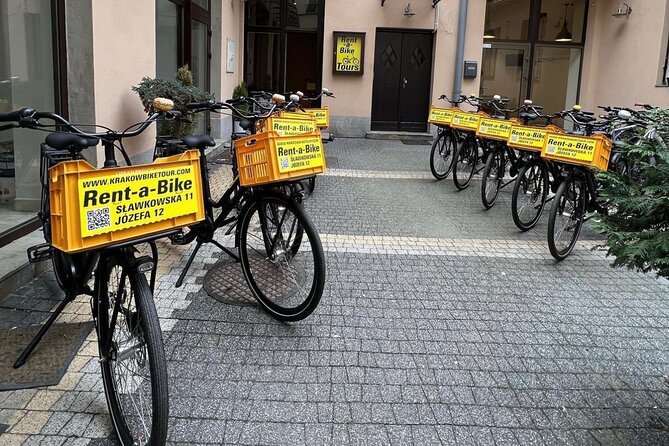
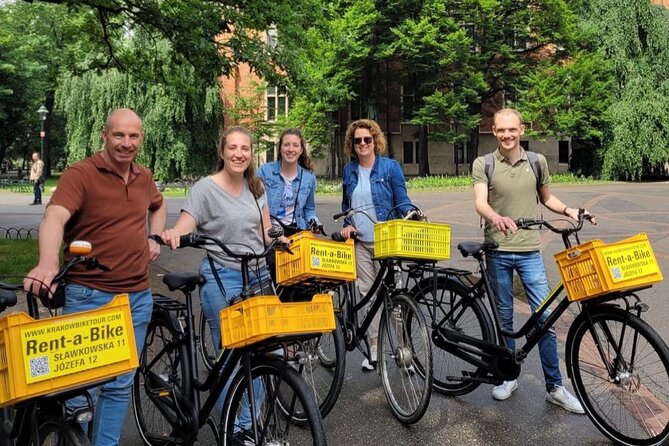
You meet at KrakowBikeTour.com, the Old Town bike shop at Sławkowska 11. The staff set you up with a bicycle and explain how to use it if needed. A toilet is available before departure, which is a small but useful detail on a three-hour outing.
The bicycles receive mostly favorable comments. Several riders describe them as comfortable, sturdy, and easy to handle on city streets. The company says the bikes are maintained regularly, and the general picture is of practical city bikes rather than high-performance machines.
One rider felt the bike quality could have been better. That is worth keeping in mind, especially if you are particular about bicycle fit or equipment. Check your bike before setting off and mention any concern to the staff right away.
Rain ponchos are provided if needed. The tour depends on good weather, so poor conditions can lead to a different date or a full refund. Children must be accompanied by an adult, and most people can take part.
Main Market Square and the city’s medieval core
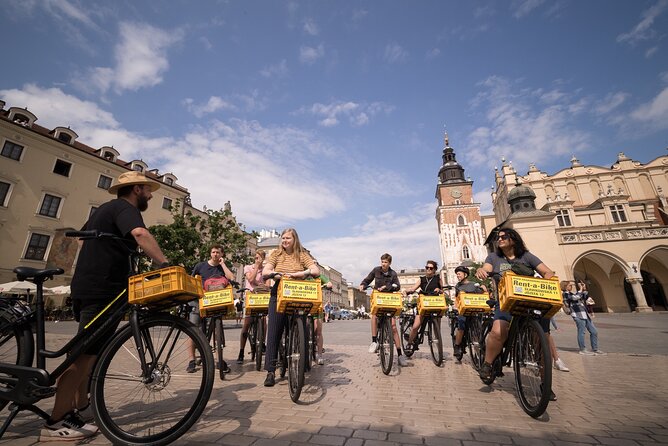
The first major stop is Stare Miasto, Krakow’s Old Town. You cycle through the Main Market Square, one of Europe’s great medieval urban spaces, and pause near the Cloth Hall, Town Hall Tower, and St. Mary’s Basilica.
The guide explains how the square worked as a trading center, including the customs of medieval merchants. You also hear the legend of the trumpeter whose short musical call rings from St. Mary’s Basilica.
This is a useful opening because the square can seem like a grand postcard until you understand how it functioned. The Cloth Hall was tied to trade, the Town Hall marked civic power, and the basilica anchored religious life. You receive enough context to make a later solo visit more meaningful.
The stop is listed at about 15 minutes. That is enough for an introduction, but not a full visit inside the church or the Cloth Hall. If you want detailed photographs or interior time, plan to return after the ride.
Collegium Maius and Krakow’s university story
The route continues to Collegium Maius, the Gothic building associated with Jagiellonian University. It is presented as Poland’s oldest university, and the guide connects the site with Nicolaus Copernicus, who studied there.
This short stop adds an academic side to Krakow’s story. The Old Town is not only a place of kings, merchants, and churches. It is also a center of learning, with a university tradition that shaped Polish public life.
Again, the emphasis is on orientation and storytelling rather than a full museum visit. Admission to the exterior stop is free, but you should not expect time for an extended interior tour as part of this bike experience.
More Kazimierz and Jewish Quarter tours in Krakow:
- Krakow: Kazimierz Jewish Quarter Walking Tour
★ 4.8 · 571 reviews - Krakow: Kazimierz, Schindler’s Factory & Ghetto Guided Tour
★ 4.8 · 460 reviews - Krakow: Bike Tour of the Old Town, Kazimierz, and the Ghetto
★ 4.9 · 350 reviews - Krakow: Jewish Quarter and Ghetto Electric Golf Cart Tour
★ 4.6 · 348 reviews
Wawel Hill, the Dragon, and Poland’s royal past
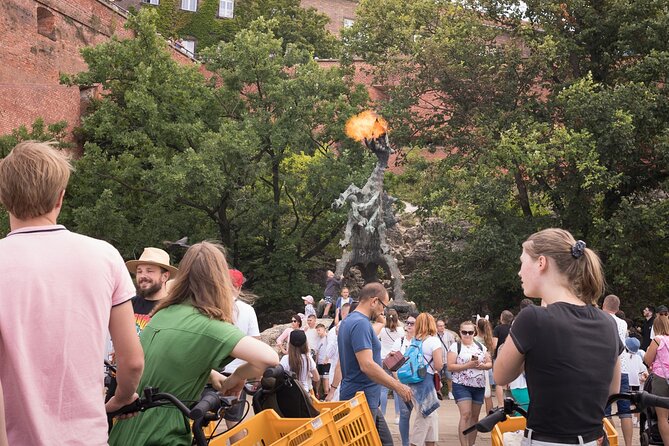
At the Monument of the Wawel Dragon, you hear the tale of the monster that once threatened Krakow and the clever craftsman who defeated it. It is a simple legend, but it gives the ride a lighter moment after the denser medieval material.
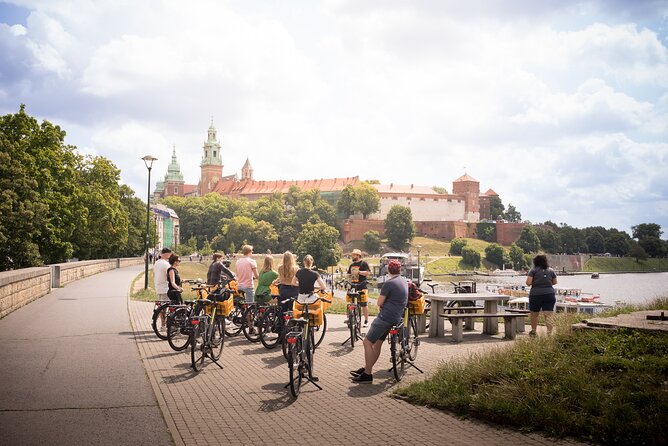
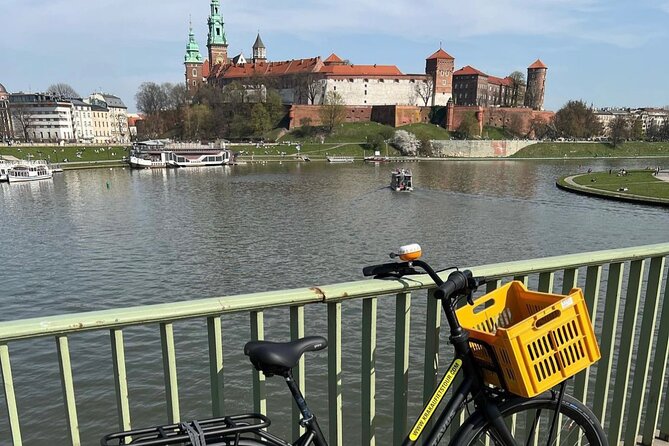
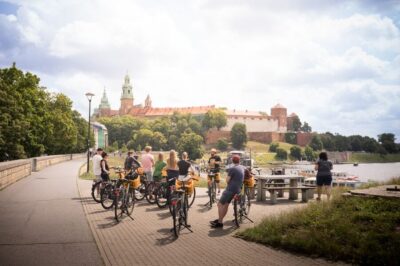
The next stop is Wawel Hill, the former seat of Polish kings. The guide explains why this hill matters to the country’s political and cultural story. You get a view of the royal complex and its position above the Vistula, but entry to Wawel Royal Castle is not included.
That distinction matters. If you want to visit the castle interiors, you will need separate time and admission. The bike tour works best as a first look at Wawel, followed by a return visit when you can choose the rooms or exhibitions that interest you.
The route then uses one of Krakow’s pleasant cycle paths, with open views and a calmer stretch of riding. This is one of the best parts of the format. You are not simply stopping at monuments; you are also seeing the city from the saddle.
Kazimierz, the former Jewish district
Kazmierz, more commonly spelled Kazimierz, is a major part of the tour. Before the Second World War, it was a center of Jewish life in Krakow. Today, it is known for cafes, galleries, restaurants, and creative businesses.
The guide places the present-day district beside its earlier role, which helps you read the streets with more care. You see a neighborhood that has changed greatly, but whose Jewish identity remains central to Krakow’s story.
The next stop is the former Jewish kosher meat market, now associated with zapiekanka, a toasted baguette topped in a pizza-like style. Food is not included, but this is a useful place to note for later. If you want to try the local snack, return after the tour rather than trying to eat while cycling.
Szeroka Street follows. It was once one of the district’s most important streets and later appeared prominently as a filming location in Steven Spielberg’s Schindler’s List. The guide can help connect the street’s modern appearance with its Jewish past and its place in the film.
The Jewish quarter is often the section people remember most, partly because it combines food, architecture, memory, and daily life. You get a strong introduction, though the short stop means you will want to come back on foot if this is your main interest.
The former Ghetto and Schindler’s factory
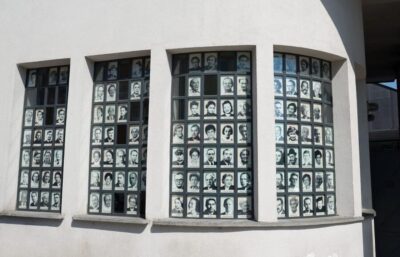
The ride crosses to Plac Bohaterów Getta, a square marked by a memorial to the victims of the Jewish Ghetto. The Pharmacy Under the Eagle is also connected with this site. This is a quieter, more serious part of the route, and the guide’s explanation gives the square historical weight beyond its physical appearance.
The stop is not designed as a museum visit. It is a chance to understand the place and decide if you want to spend more time there later. The memorial is best approached with patience, so riders who prefer long periods of reflection may find the group schedule too short.
Next comes Oskar Schindler’s former enamel factory. During the Second World War, Schindler employed and saved more than 1,000 Jewish people. The location is closely tied to the story told in Schindler’s List, but the site also belongs to Krakow’s wider wartime history.
Admission to the factory museum is not included. That is important when comparing the tour with a museum ticket or a private visit. The bike ride gives you the location and background, while a separate visit allows more time with the exhibitions.
For me, this part gives the tour its strongest historical range. You move from medieval trade and royal power to Jewish life before the war, the Ghetto, and the complicated choices made during Nazi occupation. The guide’s role is important here, since a bare list of sites would not explain how these places connect.
Planty Park, the Barbican, and St. Florian’s Gate
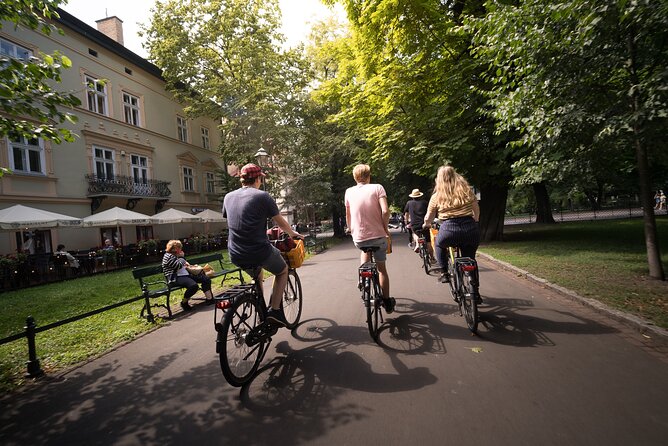
Near the end, the route relaxes in Planty Park, the green belt surrounding much of Krakow’s Old Town. The ten-minute ride is a pleasant change after the heavier material of the Ghetto and Schindler’s factory.
You then stop at the Barbican, one of the remaining pieces of Krakow’s medieval defenses. It sits near St. Florian’s Gate, once the main entrance into the city. Together, the two sites help you understand how Krakow was protected and how visitors entered the medieval center.
Entry to the Barbican museum is not included. The exterior stop is free, but you will need separate admission if you want to go inside. St. Florian’s Gate itself is included as a sightseeing stop.
The tour finishes back at the original bike shop. That makes it easy to continue exploring the Old Town, find food, or return to a site that caught your attention.
Guide quality and the feel of the ride
The strongest part of this experience is the human guide. Chris is described as a Krakow native who brings personal stories and a clear sense of care to the route. Thomas is praised for historical detail, patience, and his ability to speak French as well as English. Alex is known for enthusiasm, while Krzysztof is praised for explaining difficult subjects in an easy-to-follow way.
Mike has also led the ride for larger groups and is described as patient and informative. The company does not use an audio guide. That is a positive if you prefer conversation, questions, and a guide who can adjust the explanation to the group.
The tradeoff is that live guiding takes attention. One rider wished for more time to take photographs while the guide was speaking. I understand the problem: you cannot listen closely, photograph every angle, and keep a group moving at the same time.
My advice is to treat this as an introduction, not a photo tour. Note the places you want to revisit, then return later with your camera and more time.
Price, duration, and who gets the best value
At $35.07 per person, this is good value if you want transport between districts as well as guiding. You are paying for roughly three to four hours, bicycle use, a local guide, local taxes, and a poncho if the weather turns wet. Food, drinks, and museum admissions are extra.
The value is strongest for a first or second day in Krakow. You see enough of the city to understand its shape, and the guide can suggest places to explore afterward. It is also useful if your time is limited and you want more range than a walking tour allows.
The tour is offered in English and uses a mobile ticket. It is often booked around 20 days ahead, so I would not leave it until the final morning of a short visit. Free cancellation is available up to 24 hours before the start time. Late cancellations and changes are not refunded, and the company may cancel if the minimum number is not reached.
Should you book this Krakow bike tour?
I would book it if you want a relaxed overview that reaches beyond the Old Town. The route covers an unusually broad mix of Krakow sights, and the combination of local guides, bike lanes, and a mostly flat course makes the city feel manageable.
Choose it especially if you like history explained through places rather than long museum sessions. You will see the royal center, Jewish Kazimierz, the former Ghetto, and Schindler’s factory in one outing.
I would hesitate only if you want extensive time at each monument, dislike group schedules, or need a very high-end bicycle. For most visitors who enjoy cycling and want to get oriented quickly, this is a practical, good-value start to Krakow.
FAQ
How long does the Krakow bike tour last?
The tour lasts approximately three to four hours.
Where does the tour start?
It starts at KrakowBikeTour.com, the bike rental shop at Sławkowska 11 in Krakow’s Old Town.
Where does the tour finish?
The tour ends back at the original meeting point.
Is bicycle use included?
Yes. Use of a bicycle is included in the price.
Is the tour offered in English?
Yes. The experience is offered in English.
What places does the route visit?
The route includes Krakow’s Old Town and Main Market Square, Collegium Maius, Wawel Hill, the Wawel Dragon monument, Kazimierz, the former Jewish Ghetto, Schindler’s former factory, Planty Park, the Barbican, and St. Florian’s Gate.
Are museum admissions included?
No. Admission to Wawel Royal Castle, Schindler’s Factory, and the Barbican is not included.
Is food included?
No. Food and drinks are not included unless specifically stated.
What happens if the weather is poor?
The tour requires good weather. If it is canceled because of poor conditions, you will be offered another date or a full refund.
More bike tours in Krakow
- Complete Cracow Bike Tour (small group of maximum 15 people!)
★ 5.0 · 1,322 reviews - Highlights of Krakow Bike Tour – Small group
★ 5.0 · 662 reviews - Hidden Krakow Bike Tour
★ 5.0 · 275 reviews - Private Bike Tour in Krakow
★ 5.0 · 152 reviews
More Old Town walking tours in Krakow
- Old Town Krakow & Wawel Castle Walking Tour
★ 5.0 · 1,508 reviews - Krakow: The Old Town Walking Tour
★ 4.8 · 794 reviews - Krakow: Old Town Guided Segway Tour
★ 4.7 · 756 reviews - Kraków: Old Town & Wawel Castle Walking Tour in English
★ 4.8 · 532 reviews
Just added around Krakow
- From Krakow: Zakopane Full-Day Tour with Lunch Option★ 4.4 · 62 reviews
- From Krakow: Zalipie and Painted Village Guided Tour★ 4.0 · 4 reviews
- From Krakow: Zakopane and Dunajec River Rafting Tour★ 4.6 · 31 reviews
- From Krakow: Zakopane and the Tatra Mountains★ 4.7 · 36 reviews
- From Krakow: Zakopane and Gubałówka Cable Car Private Tour★ 4.3 · 12 reviews
- From Krakow: Zakopane Tatra Mountains & Hot Springs Tour★ 3.0 · 29 reviews
- From Krakow: Zakopane & Tatra Mountains Tour★ 3.8 · 42 reviews
- Zakopane & Tatra Mountains Private Full-Day Tour from Krakow★ 4.5 · 33 reviews
Krakow Jewish Ghetto Tours, compared.
Bike Tour of Old Town, Jewish Quarter and the Ghetto
Read our review →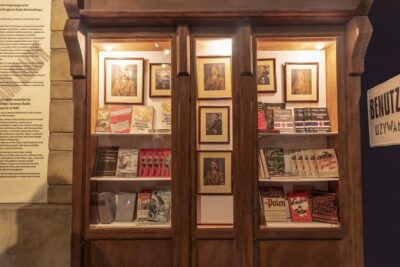
Kazimierz, Schindler’s Factory & Ghetto Guided Tour
Read our review →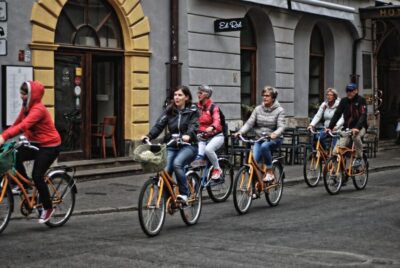
Bike Tour of the Old Town, Kazimierz, and the Ghetto
Read our review →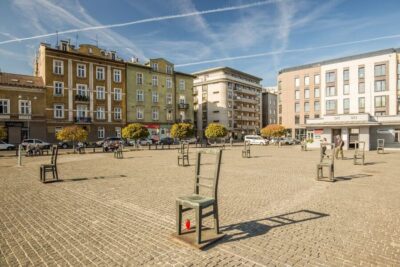
Jewish Quarter and Ghetto Electric Golf Cart Tour
Read our review →
Schindler’s Factory and Jewish Ghetto Guided Tour
Read our review →Browse the lists this tour appears in