
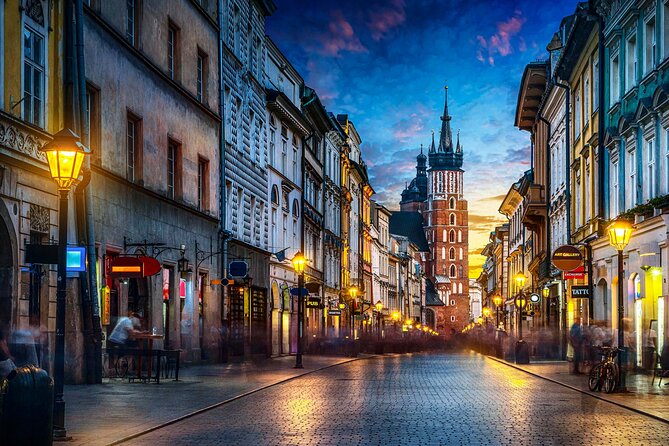
Reviewed · WALKING TOURS
Krakow Walking Tour with Audioguide on Your Smartphone
Krakow’s story unfolds in layers on this self-guided walk, from the medieval Barbican and St. Florian’s Gate to royal Wawel Hill and the Jewish quarter of Kazimierz. The route links major sights with a phone app, letting you pause, replay, and set your own pace.
I like the low price of $8.27 and the one-year access, which makes this a useful orientation tour rather than a one-time appointment. I also like the 26 recordings, offline map, and landmark images. The catch is simple: you must manage the app yourself, and a phone, headphones, transport, and admission tickets are not included.
Key points to know before you start
- A full historic sweep: The route covers the Barbican, Main Market Square, Jagiellonian University, Wawel, Kazimierz, and Ghetto Heroes’ Square.
- 26 audio recordings: A professional historian provides the narration through an iPhone or Android app.
- Flexible timing: The advertised walking time is about two and a half hours, but you can pause, replay sections, and visit sights at your own speed.
- No human guide: You meet at the Krakow Barbican, download and activate the app, then follow the route on your own.
- Useful offline tools: An offline map, GPS navigation, and landmark illustrations help you identify the correct buildings.
- Bring your own gear: Your smartphone and headphones are required. Entry tickets are separate, although the walking route itself does not require admission.
Starting at Krakow’s Barbican and St. Florian’s Gate
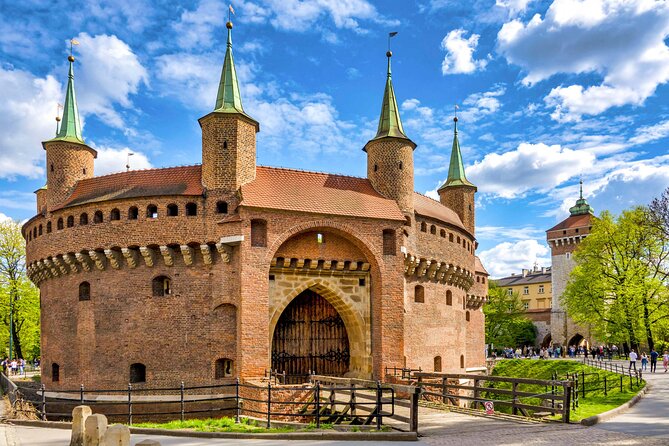
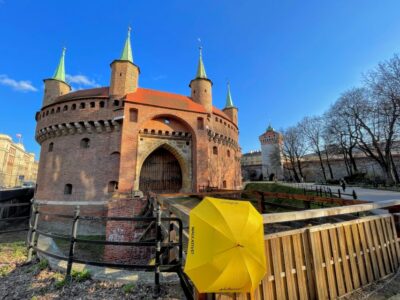
The tour begins at the Krakow Barbican on Basztowa Street, a sensible place to start because it introduces the city as a fortified medieval capital. This circular brick fortress once protected the approach to Krakow, with thick walls and seven turrets surrounding an open courtyard.
The Barbican is especially useful as a first stop because you can understand its purpose before entering the Old Town. The audio recording explains the defensive design, while the app’s illustration helps you match the narration to the building in front of you. Historical reenactments, exhibitions, and cultural events sometimes take place here, though the tour does not include admission or a scheduled event.
From the Barbican, you move to St. Florian’s Gate, one of the city’s best-known medieval landmarks. The Gothic tower rises 33.5 meters and has a later Baroque roof, a detail worth looking for as you compare the older structure with the city around it.
The gate once formed part of Krakow’s defensive walls. Walking beneath it gives you a strong sense of the old Royal Route, the ceremonial path leading toward the city center. The app gives you the background without requiring you to join a fixed group, which is handy if you want extra time for photographs.
More self-guided routes in Krakow:
- Krakow: Vistula River Sightseeing Cruise with Audio Guide
★ 4.4 · 820 reviews - From Krakow: Auschwitz-Birkenau and Self-Guided Day Tour
★ 4.1 · 576 reviews - Krakow: Sightseeing Cruise on Vistula River with Audio Guide
★ 4.4 · 480 reviews
Florianska Street leads into the Main Market Square
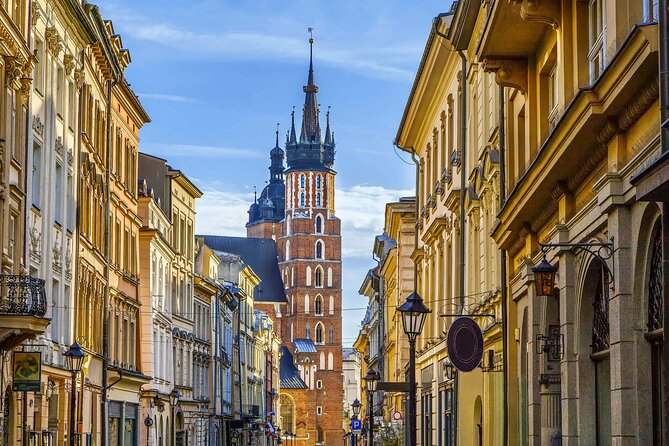
Florianska Street connects St. Florian’s Gate with the Main Market Square. This is one of the easiest parts of the route to follow, since the street naturally points you toward the center.
Look up as you walk. Medieval facades sit above modern shops, cafes, restaurants, and souvenir stores. The ten-minute stop is enough for a quick orientation, but you may want to pause the recording if you prefer to browse or stop for coffee.
The street can feel busy, particularly because it is a direct route into the square. That is not a flaw, but it means this section is more about seeing Krakow’s daily city life than finding a quiet medieval lane. The audio guide lets you stop without losing your place, so you can listen later if the street noise is distracting.
St. Mary’s Basilica and the scale of Market Square
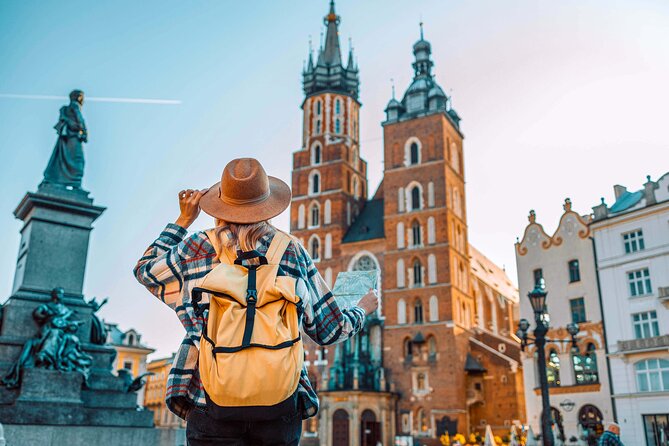
At the Main Market Square, the route brings you to St. Mary’s Basilica. This 14th-century Gothic church is known for its two unequal towers and its wooden altarpiece by Veit Stoss.
The taller tower is often called the Bugle Tower. A traditional trumpet call is played each hour, giving the building a living connection to Krakow’s past. The shorter tower is the Bell Tower, and the contrast between the two helps explain why the basilica is so recognizable from the square.
The interior includes stained glass, decorated chapels, and the large wooden altarpiece. Since entrance fees are not part of the tour, check the local access rules if you want to go inside. The audio stop still gives you useful context from outside, but the church’s art is best understood in person.
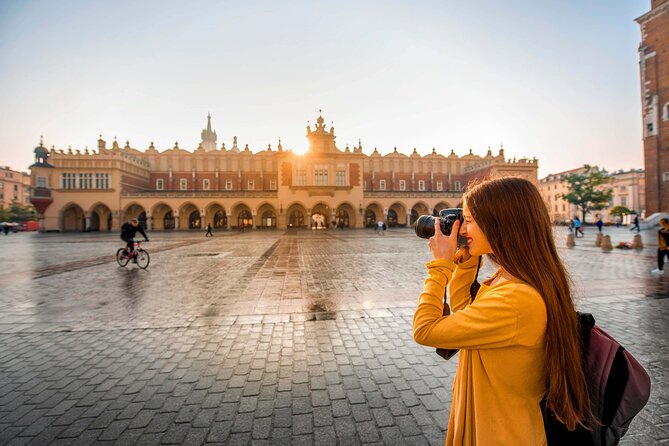
Market Square is one of Europe’s largest medieval squares. Here you can see the Cloth Hall, St. Mary’s Basilica, and the Town Hall Tower, while cafes, market stalls, and street performers fill the open space. I would pause the app here and allow extra time. Two and a half hours is enough for the route, but not enough for a relaxed visit to every major building.
Town Hall Tower and Krakow’s academic quarter
The Town Hall Tower is the last remaining part of the original 14th-century Town Hall. It rises about 70 meters above the square, and its winding staircase leads to city views and historical displays.
The tower is an optional paid sight rather than an included part of the walking experience. If you decide to climb it, treat the audio route as a guide to the building, not as an admission ticket. The tour’s value does not depend on entering every site, but the tower can add a useful view over the square and nearby streets.
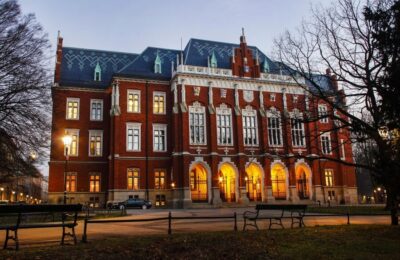
Next comes Collegium Maius, the oldest building of Jagiellonian University. Its courtyards, arcades, lecture rooms, library, and professors’ quarters show how long Krakow has been a center of learning. The university dates to 1364, and Nicolaus Copernicus studied here.
The route also identifies Collegium Iuridicum, another historic university building. Together, these stops add something many city walks miss: Krakow is not only a royal and religious center, but also an academic one. The university buildings are attractive from the outside, while the preserved interiors and scientific instruments require separate entry if you want to see them closely.
More Old Town walking tours in Krakow:
- Old Town Krakow & Wawel Castle Walking Tour
★ 5.0 · 1,508 reviews - Creepy Krakow: 2-Hour City Walking Tour
★ 4.7 · 1,131 reviews - Krakow: The Old Town Walking Tour
★ 4.8 · 794 reviews - Krakow: Kazimierz Jewish Quarter Walking Tour
★ 4.8 · 571 reviews
Kanonicza Street and Wawel Hill
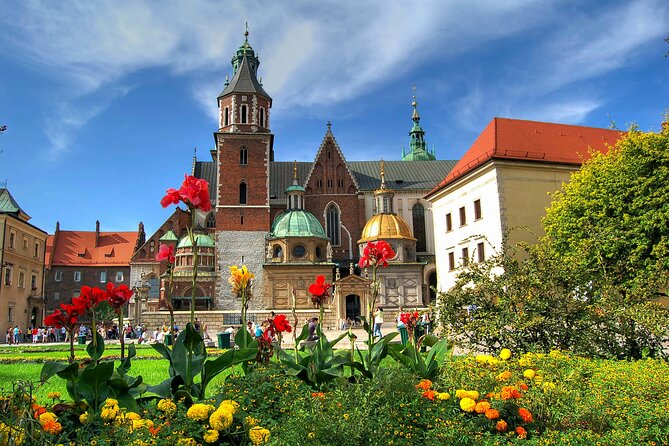
Kanonicza Street is one of the quieter parts of the Old Town route. Its cobblestones and restored Renaissance and Baroque houses create a sharp change from the busy streets near the square.
The street was associated with clergy and scholars, and its buildings include historic residences, museums, and cultural institutions. The Palace of Bishop Erasmus Ciolek is one of the key sights nearby. This early 16th-century Renaissance palace now houses a National Museum branch with medieval sculpture, religious icons, and early modern Polish art.
I like this section because the street itself does much of the work. You do not need to enter every building to appreciate the architecture, and the audio recording helps connect the facades with Krakow’s church and university life.
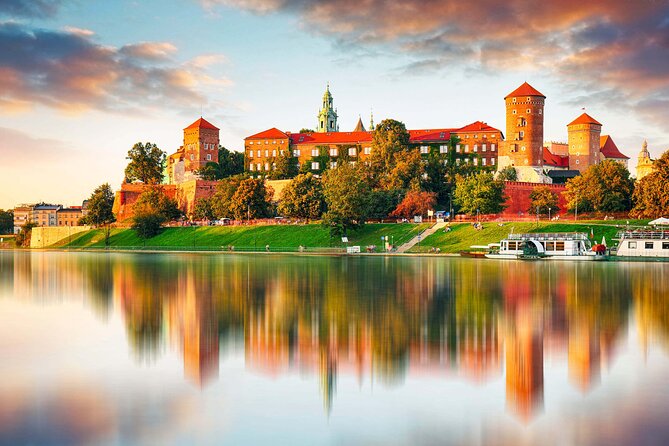
The route then climbs toward Wawel Hill, the city’s great royal and religious center. Wawel Cathedral has seen royal coronations, weddings, and funerals. Inside are royal tombs, chapels, the Sigismund Bell, and a treasury of sacred objects and royal items.
Wawel Castle adds the political side of the story. The complex includes Renaissance courtyards, state rooms, royal apartments, the Crown Treasury, and the Armory. It also offers views toward the Vistula River. These attractions require separate tickets, and you should not expect the $8.27 audio tour to provide castle admission.
For a quick walk, the Wawel section works well from the outside. If you want the full experience, plan extra time and consider returning later for the interiors. The self-guided format makes that easy because your access lasts a year rather than ending when the walk does.
From Planty Park to Kazimierz
The route continues toward the former Jewish district of Kazimierz. Along the way, it includes the Jan Karski Monument in Planty Park.
The statue shows Karski seated on a bench with a book. Karski was a Polish resistance fighter and diplomat who reported the Holocaust to Allied leaders. This is a small stop, but it adds a serious moment to the tour and connects Krakow’s public spaces with the moral choices of the Second World War.
Kazimierz then brings a different tone and subject. At the Tempel Synagogue, you can see Moorish Revival design from the outside and, if you pay separately to enter, gilded stucco, detailed woodwork, and stained glass. Built in 1862, the synagogue served progressive Jewish worship and now hosts services, concerts, and cultural events.
Okrąglak offers a more everyday view of the district. This circular former market hall is known for food stalls, especially zapiekanki, an open-faced Polish sandwich. It is a good place to pause the recording and eat, though food is not included.
Szeroka Street and the Old Synagogue
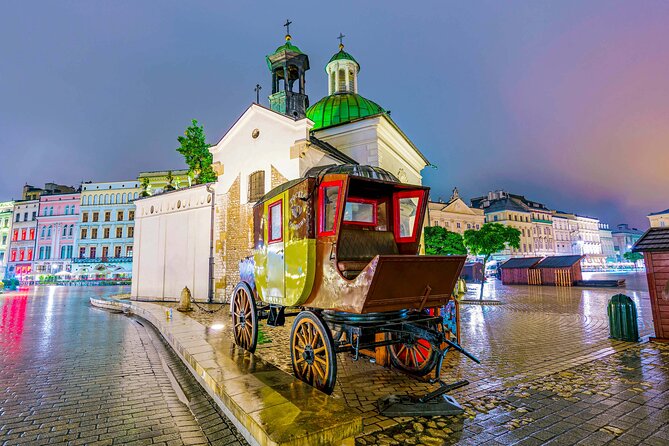
Szeroka Street is the center of Kazimierz’s Jewish heritage. The route points you toward the Old Synagogue, the Remuh Synagogue, and the adjacent cemetery, as well as cafes, restaurants, and Judaica shops.
The Old Synagogue dates to the 15th century and now operates as a museum. Its displays cover religious objects, documents, traditions, and the former Jewish community of Krakow. Again, entrance is separate, but the audio stop gives you the setting and explains why this part of Kazimierz matters.
The route handles this subject best when you slow down. Kazimierz is not simply a collection of attractive buildings. It carries memories of a community that was nearly destroyed, and the museums and memorials deserve more than a rushed photograph. Use the pause function, enter the sites you choose, and resume the tour afterward.
Ghetto Heroes’ Square and the final reflection
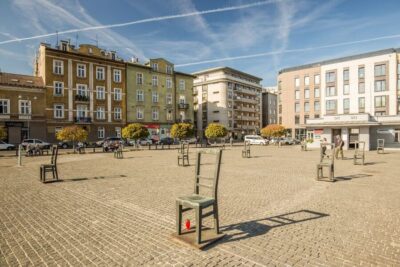
The final major stop is Ghetto Heroes’ Square in Podgórze. During the Second World War, this was part of the Krakow Ghetto and a place connected with deportations.
Today, 70 empty metal chairs mark the absence of the people who were forced from their homes. The memorial is direct and quiet, giving the tour a weightier ending than a simple return to the Old Town.
This stop is also a reminder that Krakow’s story cannot be reduced to castles, churches, and handsome streets. The route links royal history with Jewish life, wartime loss, and later remembrance. I would allow time here to listen without rushing to the next point.
How the smartphone format works on the street
You download the audio guide app for iPhone or Android, activate the purchase, and follow the route on the app’s map. The tour includes 26 recordings, landmark illustrations, and GPS navigation. The map can be downloaded for offline use, which is a smart step before leaving your hotel or accommodation.
The format gives you control. You can pause for a church visit, replay a section you missed, or stop for food in Kazimierz. You can also use the tour at any time, since the date and time selected during checkout are approximate rather than a fixed appointment.
The tradeoff is that you are responsible for the technology. You need a charged smartphone, headphones, and enough confidence to follow a map. If you rely only on live directions through Google Maps and the app, the process may feel less smooth, so download the route and activate GPS before you begin.
There is no guide waiting at the Barbican. The advertised group limit is 20 people, but this is still a self-guided activity, not a walking group with a leader. That distinction matters if you want questions answered on the spot.
Is $8.27 good value?
At $8.27 per person, this is inexpensive for a two-and-a-half-hour introduction to Krakow. The strongest value comes from the breadth of the route and the one-year access. You can use it as a first walk, then return to Wawel, Kazimierz, or the Old Town later.
The price does not cover a smartphone, headphones, transportation, or entry tickets. Those exclusions are reasonable for a digital walking guide, but they make the tour less suitable if you want one payment to cover a complete sightseeing day.
I see it as a map, history lesson, and orientation tool in one. It is not a substitute for an expert guide at Wawel Castle or the Old Synagogue, especially if you have detailed questions. It is a practical way to connect the main districts before deciding where to spend more time.
Who should book this Krakow walk?
I would choose this tour if you like independent sightseeing, want to avoid a fixed departure time, or need a quick introduction to Krakow. It also suits repeat visitors who want a route through familiar areas with historical context.
It is a good match for people who enjoy stopping often. You can take photographs, eat zapiekanki, enter selected museums, and resume the narration when ready. The ability to pause and restart is one of the format’s best features.
I would think twice if you dislike navigating with a phone or expect a person to lead the way. The tour requires preparation, and cold weather can make extended phone use and outdoor listening unpleasant. Wear suitable clothing, charge your phone, and download the map before starting.
Free cancellation is available up to 24 hours before the scheduled start time. Inside that window, the payment is not refundable, and changes are not accepted.
Should you book it?
Book it if you want a cheap, flexible route through Krakow’s major historic districts and are comfortable being your own guide. The Barbican, Market Square, university quarter, Wawel, Kazimierz, and Ghetto Heroes’ Square create a strong first look at the city.
Skip it if your priority is a live guide, included admissions, or detailed help inside museums and churches. For everyone else, $8.27 buys a useful audio route with enough flexibility to turn a short orientation walk into a longer self-planned day.
FAQ
Where does the Krakow audio tour start?
It starts at the Krakow Barbican on Basztowa Street, Krakow, Poland.
Where does the tour finish?
The activity ends back at the meeting point.
How long does the walking tour take?
The estimated duration is about two hours and 30 minutes.
Is there a human guide?
No. This is a self-guided tour delivered through a mobile app, and no guide will be waiting at the meeting point.
What languages are available?
The tour is offered in English.
What is included?
You receive one year of access, 26 audio recordings narrated by a professional historian, an iPhone and Android audio guide app, landmark illustrations, and an offline map with GPS route guidance.
Do I need to bring headphones?
Yes. Headphones are not included, so you need to bring your own.
Are entrance tickets included?
No. Entrance fees and tickets are not included. The walking route itself does not require an entry fee.
Can I cancel for a full refund?
Yes, if you cancel at least 24 hours before the experience start time. Cancellations made less than 24 hours before the start time are not refunded.
Just added around Krakow
- From Krakow: Zakopane Full-Day Tour with Lunch Option★ 4.4 · 62 reviews
- From Krakow: Zalipie and Painted Village Guided Tour★ 4.0 · 4 reviews
- From Krakow: Zakopane and Dunajec River Rafting Tour★ 4.6 · 31 reviews
- From Krakow: Zakopane and the Tatra Mountains★ 4.7 · 36 reviews
- From Krakow: Zakopane and Gubałówka Cable Car Private Tour★ 4.3 · 12 reviews
- From Krakow: Zakopane Tatra Mountains & Hot Springs Tour★ 3.0 · 29 reviews
- From Krakow: Hot Springs and Zakopane with Gubałówka★ 4.7 · 25 reviews
- From Krakow: Zakopane & Tatra Mountains Tour★ 3.8 · 42 reviews
Walking Tours, compared.
Old Town & Wawel Castle Walking Tour in English
Read our review →
Browse the lists this tour appears in