
Reviewed · KRAKOW GOLF CART TOURS
The best view of Krakow from Golf Cars
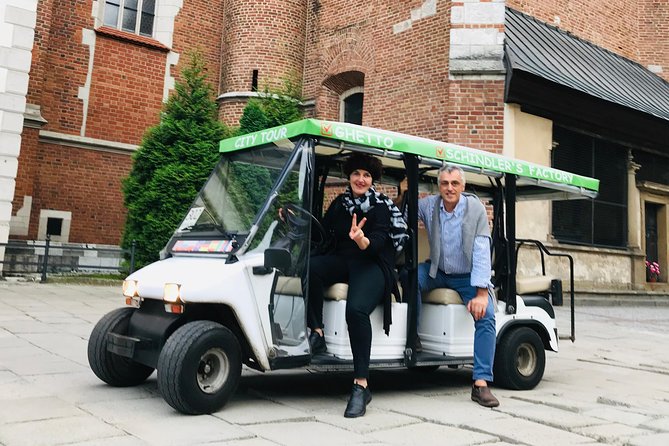
Krakow is easiest to understand from street level, and this two-hour electric golf-cart tour gets you from the medieval Old Town to Kazimierz and the former ghetto without tiring your feet. The small vehicle can use streets that large buses cannot, giving you a closer look at churches, synagogues, squares, and river crossings.
I like the maximum group size of seven and the 26-language audio system. I also like the route itself: it is not just a loop around the Main Market Square, but a broad sweep through Wawel, Kazimierz, and Podgórze. The main concern is reliability. Two very unhappy customers reported that their carts never arrived, so confirm the meeting details and keep your booking information handy.
The tour is best for first-time visitors who want a fast orientation, people who prefer not to walk long distances, and families or small groups that can share the fixed price. It is less suitable if you want long visits inside museums or churches, since most stops are brief photo and explanation breaks.
Key points before you book
- A route across three historic districts: You travel through the Old Town, Kazimierz, and Podgórze in one compact outing.
- A private-group price: The $103.03 rate covers up to seven people, making it much better value when the cart is full.
- Short but useful stops: Wawel Dragon, Church on the Rock, Corpus Christi Church, Szeroka Street, and Ghetto Heroes Square each receive about 5 to 10 minutes.
- Audio in 26 languages: You can listen in your own language while the English-speaking driver adds information during the drive.
- Good access to narrow streets: The cart reaches parts of Krakow that large sightseeing buses cannot.
- Weather needs clarification: Vehicle covers are provided for cold or rainy days, but the terms also allow cancellation in poor weather.
A quick ride from Matejki Square into Krakow
The meeting point is at plac Jana Matejki 2, near public transportation and just outside the Old Town. From here, the route moves toward the historic centre, giving you a useful first look at Krakow’s old defensive edge.
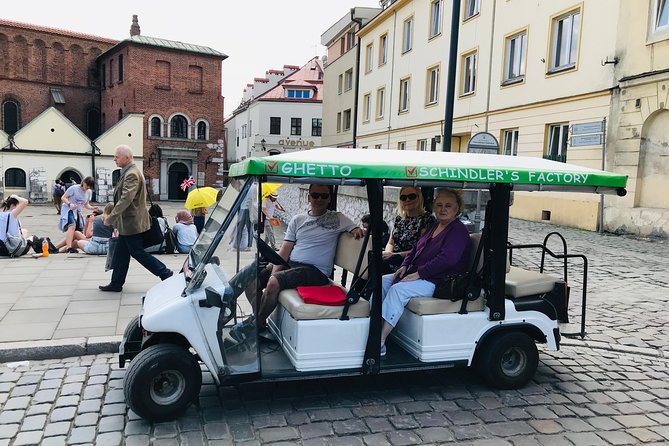
The vehicle is an electric golf cart rather than a sightseeing bus. That matters. You sit close to the street, move at a slower pace, and can get nearer to buildings and smaller lanes. You also avoid the physical effort of walking several kilometres between the Old Town, Wawel Hill, and Kazimierz.
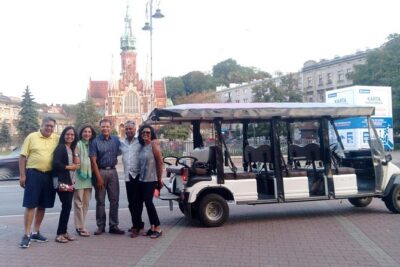
The cart carries no more than seven people. For a family or group of friends, that is a comfortable size. You are not lost in a large crowd, and the English-speaking driver can answer questions and help with photos. One especially well-received outing named Mikhal as a friendly English-speaking guide who offered useful facts and drove safely. The provider is Michal Urban, so check the confirmation for the exact driver assigned to your date.
An audio guide is available in 26 languages. During stops, you can listen to the recorded explanation in your chosen language, while the driver gives additional information in English as the cart moves. This arrangement works well for mixed-language groups, though you should not expect a long live lecture at every monument.
More electric golf cart tours in Krakow:
- Krakow: City Sightseeing Tour by Electric Golf Cart
★ 4.5 · 3,264 reviews - Krakow: City Sightseeing Tour Eco Electric Buggy Golf Cart
★ 4.7 · 3,143 reviews - Krakow: Extended City Sightseeing Tour – Eco Buggy Golf Cart
★ 4.7 · 794 reviews
Krakow’s northern gateway and the Grunwald Monument
One of the early sights is the historic gateway built around 1498. It once formed part of the entrance into Krakow’s Old Town and helps you picture the city as a walled medieval centre rather than the open urban area you see today.
The route also reaches the Grunwald Monument, a large patriotic memorial dedicated to the Battle of Grunwald. That medieval battle was a major victory shared by Poland and Lithuania, and the monument remains an important symbol of Polish national pride.
You will not have time for a long visit at each of these first sights. Think of them as orientation points. The driver’s explanation gives you the basic story, while the cart keeps moving toward the older core of the city.
Planty Park and the road to Wawel Castle
Planty is one of Krakow’s most useful urban spaces. The long park circles the Old Town where the medieval walls once stood until the early 19th century. From the cart, you can connect the vanished fortifications with the modern city, seeing how Krakow grew beyond its original defensive ring.
The route then heads toward Wawel Castle, the former residence of Poland’s kings and one of the country’s strongest symbols of statehood. Wawel is part of the UNESCO-listed Historic Centre of Krakow and now contains major art collections.
This stop is valuable even if you do not enter the castle. A short exterior visit gives you the setting and basic context, while the cart leaves you free to return later for a slower look at the castle interiors. If you already plan a full Wawel visit, treat this tour stop as an introduction rather than a substitute.
Near the foot of Wawel Hill, you stop at the Monument of the Wawel Dragon. Polish folklore places the dragon’s cave beside the Vistula River. The stop lasts about 10 minutes and has no separate admission charge. It is one of the more playful moments on a route that later turns toward churches, Jewish heritage, and wartime memory.
Churches below Wawel Hill
The Bernardine Church sits directly beneath Wawel Hill. Its current building dates from the second half of the 17th century, and its location makes it an easy companion to the castle visit.
The route also includes a baroque church built between 1719 and 1728. The supplied details do not identify this church by name, so your driver’s explanation is important here. You will hear about the building during the ride, but the short format means the stop is mainly for a look from outside.
Then comes Church on the Rock, or Kosciol na Skalce. A church has occupied this site for centuries. King Casimir III built a Gothic church here, and since 1472 the shrine has belonged to the Pauline Fathers. Its later baroque decoration dates from 1733 to 1751.
The Church on the Rock receives about 10 minutes, with free admission listed. That is enough to appreciate its place in Krakow’s religious story, but not enough for a quiet architectural study. If this church matters to you, note it as a place to revisit on foot.
Same city, a completely different sort of day:
- From Krakow: Auschwitz-Birkenau Guided Tour & Hotel Pickup
★ 4.5 · 33,358 reviews - From Krakow: Auschwitz-Birkenau Guided Tour & Hotel Pickup
★ 4.5 · 29,340 reviews - Krakow: Auschwitz Guided Tour with Optional Hotel Pickup
★ 4.5 · 15,280 reviews - Krakow–Zakopane: Cable Car, Chocholow Baths, Cheese & Vodka
★ 5.0 · 10,720 reviews
Kazimierz, from Wolnica Square to the Vistula
Wolnica Square introduces you to Kazimierz, the district that became Krakow’s Jewish centre and is now one of the city’s most important historic areas. The square formed part of the old market area of Kazimierz, which was once a separate town.
The cart then crosses the Father Bernatek Footbridge over the Vistula. The bridge links Kazimierz with Podgórze and is one of the clearest geographic transitions on the route. You move from the former Jewish district toward the area connected with the Krakow Ghetto.
The footbridge stop lasts about five minutes and is free. That is enough to take photos and understand the connection between the two districts. It is not a long riverside pause, so keep your camera ready before you arrive.
Corpus Christi Church receives about 10 minutes. King Casimir III founded the Gothic church in 1335, and its interior combines Polish Gothic forms with impressive Polish baroque decoration. The brief stop lets you see why the building matters, though admission details are not listed for this stop. Ask the driver whether the visit is exterior only on your departure date.
The synagogues and squares of Kazimierz
The Kazimierz section is the heart of the tour. It brings together religious buildings, former market spaces, and streets that still carry the shape of the old Jewish district.
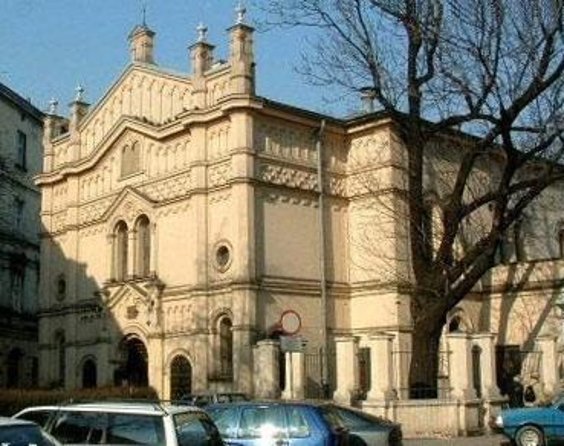
Tempel Synagogue was built in the 1860s as a progressive synagogue. The visit lasts about five minutes, and admission is not included. You should budget separately if you hope to enter any of the synagogues, since the tour price covers the vehicle, guide system, driver, and photos rather than entrance tickets.
The route also passes synagogues built in the 1620s, 1640s, and 1530s. One was badly damaged during the German occupation and another now serves as a cultural centre, including workshops and lectures during the Jewish Culture Festival. These short drive-by explanations are useful because they show that Kazimierz is not one single monument. It is a whole district shaped by religious life, war, survival, and present-day culture.
You will see Plac Nowy, a square that was part of the Jewish city from the late 16th century to the mid-19th century. Its most recognizable feature is the Okrąglak, a covered market hall built around 1899 to 1900.
The High Synagogue also appears along the route. It was the third synagogue built in the Jewish city. The tour gives you the location and historical setting, but do not expect time for a full interior visit at every synagogue.
Szeroka Street and the Old Synagogue
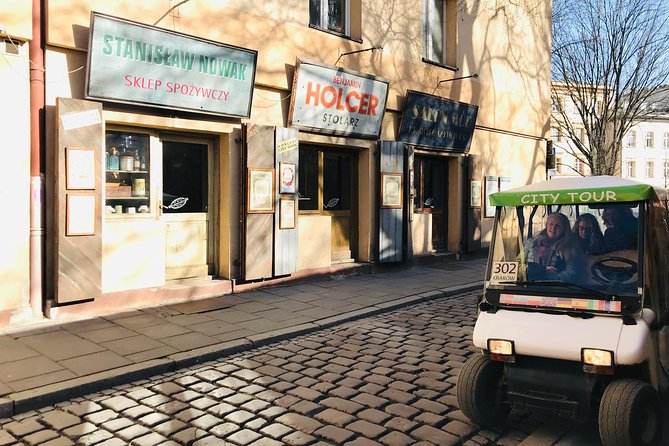
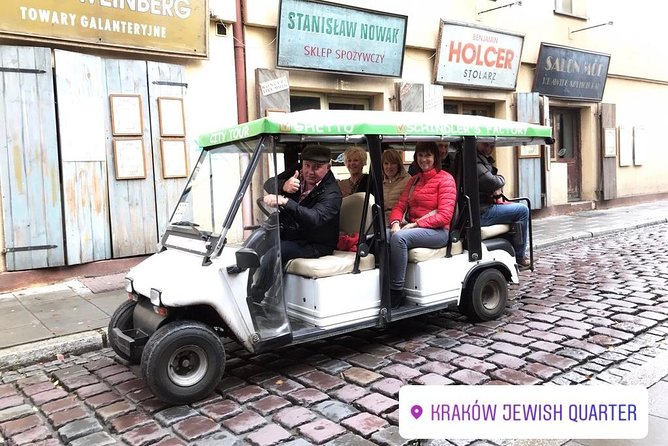
Szeroka Street is described as the heart of Krakow’s Jewish district. It is one of the most useful places on the route for understanding Kazimierz as a former Jewish town rather than simply a collection of attractive streets.
The Old Synagogue, now part of the Museum of Krakow, is one of the main stops. It was built in 1407 or 1492, depending on the date used, and contains a permanent display of Judaica. The stop lasts about 10 minutes, but admission is not included.
That combination of a short time and separate admission is worth noting. If you want to visit the museum properly, plan another visit after the cart tour. If you only want orientation, the stop gives you enough information to mark it on your map.
The route also points out the synagogue built in the 1620s and the house where Helena Rubinstein was born. These details add a personal and social dimension to the district. You are not only seeing grand religious buildings. You are also tracing the lives and institutions that shaped Kazimierz.
Remuh Synagogue and the cemetery connection
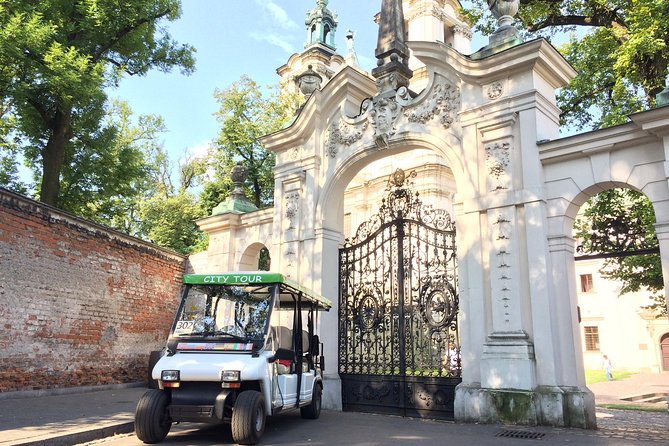
Remuh Synagogue is another 10-minute stop, with admission not included. The complex dates from the mid-16th century and remains a centre of religious life. It is known for its Jewish architecture and sacred art.
As with the Old Synagogue, the short stop works best as a first look. You can learn the basic story, take photos where permitted, and decide if you want to return for more time. The tour does not give you enough time to treat every synagogue as a full museum visit.
For many people, this is the most meaningful part of the route. The close grouping of synagogues and historic streets makes Kazimierz easier to understand than it would be from isolated visits. You also avoid spending your first hours trying to work out which sites belong together.
Podgórze and the memory of the Krakow Ghetto
After Kazimierz, the route continues into Podgórze. At Plac Bohaterów Getta, or Ghetto Heroes Square, you reach one of the most serious stops of the tour. Nazi Germany created the Krakow Ghetto as one of five major metropolitan Jewish ghettos.
The stop lasts about five minutes and is free. That is a short time for a difficult subject, so listen carefully to the audio guide and the driver. You may want to return later for a quieter visit, especially if you plan to see the nearby museum sites.
The route also points out the pharmacy that operated as the only pharmacy inside the Krakow Ghetto. It now contains a museum exhibition. Admission is not listed as included, so treat it as a separate visit.
You also see a surviving fragment of the ghetto wall on Lwowska Street and the former entry gate area at the beginning of Limanowskiego Street, near Podgórze Market Square. These are brief stops, but together they make the geography of the ghetto clearer.
Church of St. Joseph, on Podgórski Square, closes the route. The church dates from the 20th century and offers a final architectural change after the medieval churches and Kazimierz synagogues. The stop lasts about five minutes before the cart returns to the original meeting point.
What the $103.03 group price really means
The listed price is $103.03 for one group of up to seven people. At full capacity, that works out to about $14.72 per person for two hours. That is a strong price for a private small-group ride, especially if your group wants to avoid arranging several separate taxis or paying individual tour rates.
The value drops for a very small group. Two people would pay roughly $51.52 each, before any admission fees. In that case, compare the cost with a regular walking tour or public transport, especially if you are comfortable covering the Old Town and Kazimierz on foot.
The price includes the electric golf cart, English-speaking driver, audio guide in 26 languages, and photos during the tour. Food and drinks are not included. Entrance to Tempel Synagogue, the Old Synagogue, and Remuh Synagogue is also not included, so set aside extra money if you want to go inside.
The cart is covered for cold and rainy days, but the operating terms also say the activity requires good weather and may be cancelled in poor conditions. I would confirm the weather arrangement directly before departure. Two customers reported that their reserved carts did not arrive, which is a serious service concern despite the otherwise positive comments about friendly drivers and clear explanations.
Who should choose this Krakow tour
I would choose this tour if you have only a short time in Krakow and want to connect the major districts quickly. It also suits families, older adults, and anyone who wants to save their legs while still seeing more than the central square.
It works particularly well for groups of four to seven. You get a private-feeling ride without the cost becoming too high per person. The audio guide helps if not everyone in your group speaks English, while the driver can add information and stop for photos.
I would not choose it as your only Krakow experience if you want long museum visits, detailed church interiors, or extended time in Kazimierz. Use it as a first orientation, then return to Wawel, the Old Synagogue, Remuh Synagogue, or the Ghetto Pharmacy on foot.
Should you book the golf-cart tour?
Book it if you value coverage and convenience more than long visits at individual monuments. In two hours, you see the Old Town edge, Planty, Wawel, Kazimierz, the Vistula crossing, and Podgórze. Few walking tours cover that much ground without leaving you exhausted.
I would be cautious if your schedule is tight and missing the vehicle would ruin the day. Confirm the pickup point at plac Jana Matejki 2, keep the provider’s contact details available, and clarify the weather policy. For a full group of up to seven, the price is persuasive. For one or two people, the value is less clear.
FAQ
Where does the Krakow golf-cart tour start and finish?
The tour starts at plac Jana Matejki 2, 31-157 Kraków, Poland. It ends back at the same meeting point.
How long does the tour last?
The tour lasts about two hours.
How many people can join one booking?
One booking covers a group of one to seven people. The vehicle has a maximum of seven participants.
Is the tour available in languages other than English?
Yes. An audio guide is available in 26 languages. The driver speaks English.
Are attraction admission fees included?
No. Food and drinks are not included, and admission is not included for listed synagogue stops such as Tempel Synagogue, the Old Synagogue, and Remuh Synagogue.
Can the tour operate in cold or rainy weather?
The vehicles have special covers for cold and rainy days. However, the activity terms say it requires good weather and may be cancelled in poor conditions, with a different date or full refund offered.
Just added around Krakow
- From Krakow: Zakopane Full-Day Tour with Lunch Option★ 4.4 · 62 reviews
- From Krakow: Zalipie and Painted Village Guided Tour★ 4.0 · 4 reviews
- From Krakow: Zakopane and Dunajec River Rafting Tour★ 4.6 · 31 reviews
- From Krakow: Zakopane and the Tatra Mountains★ 4.7 · 36 reviews
- From Krakow: Zakopane and Gubałówka Cable Car Private Tour★ 4.3 · 12 reviews
- From Krakow: Zakopane Tatra Mountains & Hot Springs Tour★ 3.0 · 29 reviews
- Zakopane & Tatra Mountains Private Full-Day Tour from Krakow★ 4.5 · 33 reviews
- From Krakow: Hot Springs and Zakopane with Gubałówka★ 4.7 · 25 reviews
Krakow Golf Cart Tours, compared.
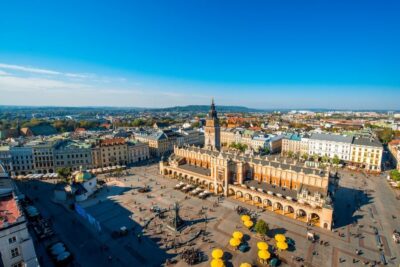
City Sightseeing Tour Eco Electric Buggy Golf Cart
Read our review →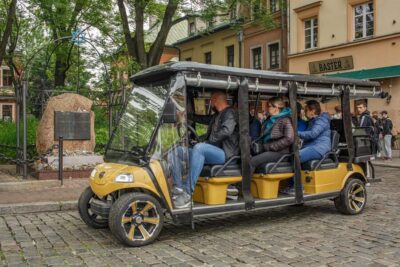
Extended City Sightseeing Tour – Eco Buggy Golf Cart
Read our review →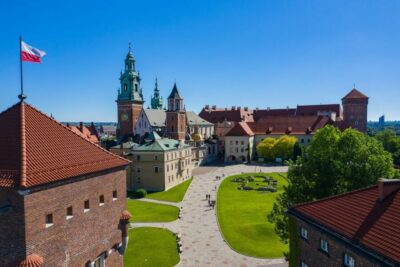
Guided City Tour by Golf Buggy (with hotel pickup)
Read our review →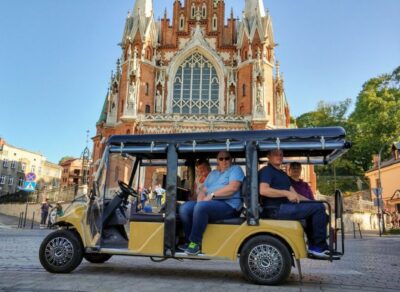
Jewish Quarter and Ghetto Electric Golf Cart Tour
Read our review →City Sightseeing Tour Eco Electric Buggy Golf Cart
Read our review →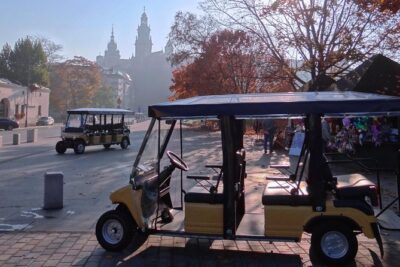
Krakow Grand City Tour by golf cart – All 3 districts
Read our review →Browse the lists this tour appears in