
Reviewed · KRAKOW JEWISH QUARTER TOURS
Kraków old town and jewish quarter®
Kraków makes sense when you connect its buildings to the events that shaped Poland. This three-hour walk links the Old Town and Kazimierz, taking you from medieval walls and the Market Square to Wawel and the former Jewish quarter with a Spanish-speaking historian.
I like the strong route: you see the city’s main sights without wasting time on transport. I also like the teaching style promised here, with maps, photos, and drawings that make difficult history easier to follow. Guide Luis has been praised for clear, lively explanations and genuine passion for the subject.
The catch is simple: three hours is a lot of ground for two major districts. You will get a useful city-wide introduction, but some stops receive only a brief look, and Kraków’s cold or snowy weather can make the outdoor pace harder.
Key points to know before booking
- Two essential districts in one walk: Cover Kraków’s historic center and Kazimierz in a single three-hour route.
- A history-led experience: A graduate guide in Geography and History explains how events in Kraków connect to wider Polish history.
- Wawel is part of the route: Visit the hill, cathedral, castle complex, and dragon sculpture from the outside route perspective.
- Kazimierz receives serious attention: Learn about Jewish settlement, Catholic and Jewish coexistence, wartime persecution, and memorials.
- Spanish-language guiding: The live tour is offered in Spanish, with Luis named as one guide.
- Good value at $16: There is no food or drink included, but the price is low for a focused three-hour introduction.
Why this route works for a first look at Kraków
Kraków is compact in the center, but its story is not. A royal capital, university town, Catholic center, and major Jewish community all left their mark within a walkable area.
This tour gives you a useful framework instead of treating the city as a parade of pretty façades. You begin with Kraków’s medieval and civic heart, continue through the university and church district, climb toward Wawel, and then move into Kazimierz. That order helps you see how power, religion, education, and trade shaped the city.
I especially like the connection between the two districts. The Old Town can feel polished and monumental, while Kazimierz carries a more layered and sometimes painful story. Seeing both in one outing keeps you from reducing Kraków to either medieval architecture or wartime memory alone.
The guide is a graduate in Geography and History, and the tour is designed around explanation rather than a quick checklist. Luis is named as a guide for this experience. His approach includes photos and drawings, which can be useful when a building or event has changed greatly over time.
More Kazimierz and Jewish Quarter tours in Krakow:
- Krakow: Jewish Quarter and Former Ghetto Tour
★ 4.9 · 1,441 reviews - Krakow: Bike Tour of Old Town, Jewish Quarter and the Ghetto
★ 4.9 · 1,155 reviews - Krakow: Kazimierz Jewish Quarter Walking Tour
★ 4.8 · 571 reviews
From the Juliusz Słowacki Theatre to St. Florian’s Gate
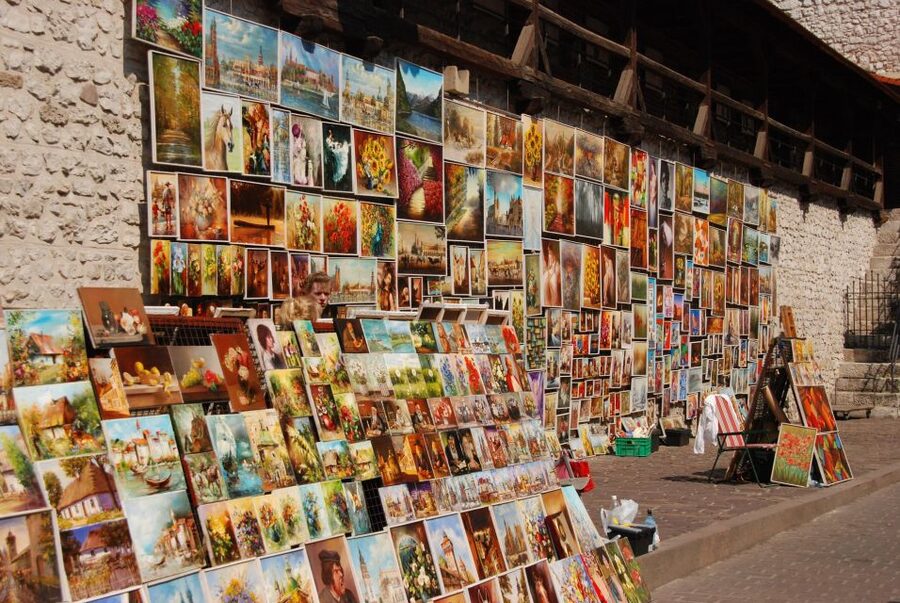
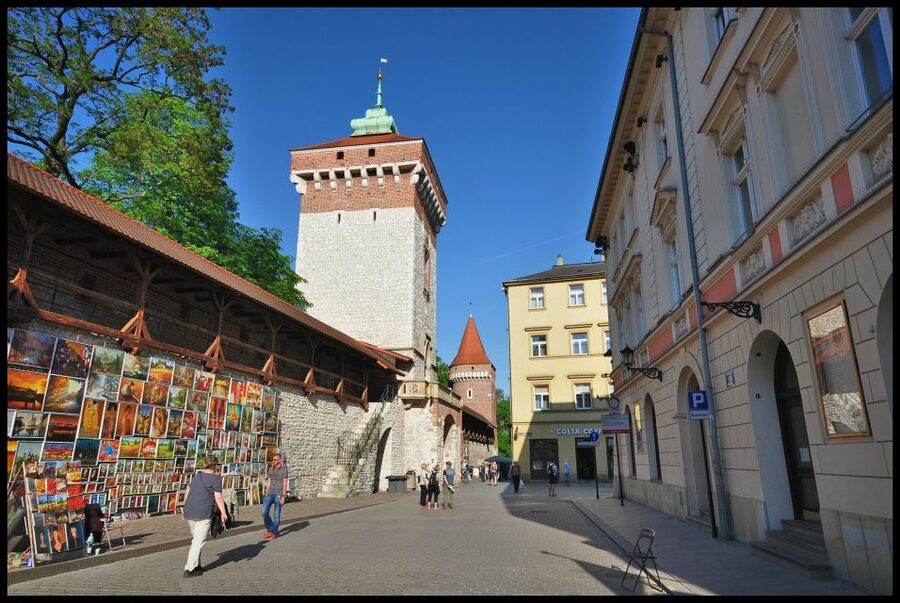
The walk begins near the downtown edge with the Juliusz Słowacki Theatre, medieval walls, the Barbican, and St. Florian’s Gate. This is a smart opening because it gives you the physical outline of old Kraków before you enter its main ceremonial space.
The medieval walls once defined and protected the city. The Barbican and St. Florian’s Gate help you picture Kraków as a fortified settlement rather than the open urban center you see today. The theatre adds a later cultural layer, showing that Kraków’s identity was not frozen in the Middle Ages.
You will want comfortable shoes here. The route is a walking tour, and the full itinerary covers a wide area. The tour is wheelchair accessible, but the detailed route includes historic streets, a hill at Wawel, and several outdoor areas. If mobility is a concern, ask the provider how the day’s exact path will be handled.
At the meeting point, look for the guide carrying a gray umbrella. A map is also provided to help you reach the starting point, which is useful if you are not yet familiar with Kraków’s central streets.
The Market Square and its monuments
The Market Square is the visual center of the Old Town and one of the places where the guide’s wider approach should pay off. The route covers St. Mary’s Basilica, Sukiennice, the old Town Hall Tower, Eros Bendato, St. Adalbert’s Church, Adam Mickiewicz Monument, and the marketplace.
This is a lot for one square, so listen for the relationships between the buildings. Sukiennice recalls Kraków’s commercial role. St. Mary’s Basilica brings religious power into the same space. The old Town Hall Tower points to civic government, while the monuments and public art show how later generations chose to remember the city.
St. Adalbert’s Church adds an older religious layer at the edge of the square. Adam Mickiewicz’s monument connects the city to Polish national culture. Eros Bendato, a modern sculpture, gives the square a contemporary note among its historic architecture.
The advantage of seeing these sights with a guide is that you can move beyond the standard photo stops. The drawback is time. The Market Square alone rewards a slow look, but this itinerary must keep moving toward Wawel and Kazimierz.
Collegium Maius and Kraków’s academic quarter
The route then enters the university neighborhood, including Collegium Maius. This section adds an important side to Kraków: it is not only a royal and religious center, but also a place shaped by study and scholarship.
The University of Kraków is associated with figures such as John Paul II and Nicolaus Copernicus, both of whom received academic training here. That connection makes the university district more than a pretty collection of old courtyards. It places Kraków within the history of European education and Polish intellectual life.
Collegium Maius is especially valuable on a walking route because its architecture helps you picture the older academic world. You may not have time for an interior visit, since the experience is organized as a city walk rather than a museum tour, but the guide can explain why this area matters.
I would pay attention here even if your main interest is architecture. The university quarter helps explain why Kraków remained important even when political power shifted elsewhere.
More Old Town walking tours in Krakow:
- Old Town Krakow & Wawel Castle Walking Tour
★ 5.0 · 1,508 reviews - Krakow: The Old Town Walking Tour
★ 4.8 · 794 reviews - Krakow: Old Town Guided Segway Tour
★ 4.7 · 756 reviews - Kraków: Old Town & Wawel Castle Walking Tour in English
★ 4.8 · 532 reviews
The Archbishop’s Palace and Franciscan Basilica
The Archbishop’s Palace and Franciscan Basilica bring the route back to religious and modern Polish history. The palace is closely associated with John Paul II, while the Franciscan church adds another major architectural and spiritual stop.
These sites also help connect Kraków to Poland’s Catholic identity. The tour is not limited to dates and rulers. It looks at institutions that shaped daily life and public memory, including the church, the university, and the monarchy.
A historian’s explanation is useful here because religious buildings can otherwise blur together after several hours of sightseeing. You can ask the guide to separate the role of the palace, basilica, cathedral, and other churches rather than treating them as one long list of ornate interiors.
The tour’s Spanish-language format is a major reason to choose it. If you are more comfortable learning history in Spanish, you can follow the explanations without constantly translating complicated names and events in your head.
Wawel Hill, the cathedral, and the dragon
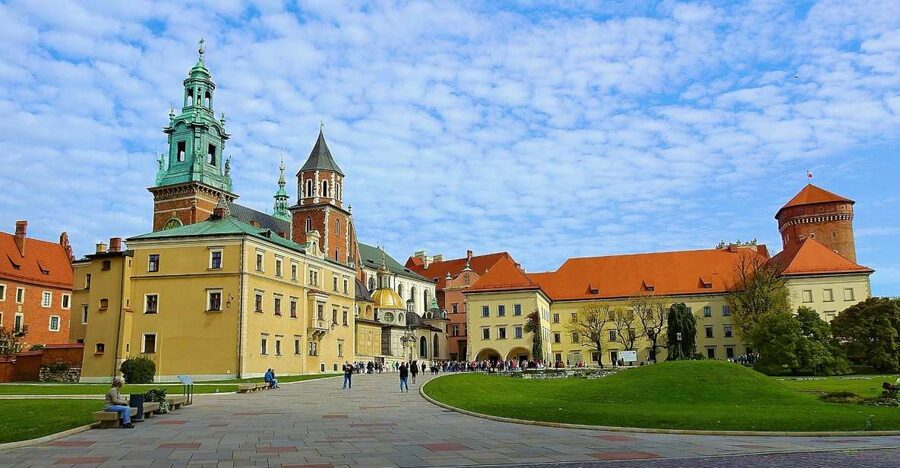
Wawel is the route’s grandest architectural stop. You ascend the hill to examine the cathedral and the wider Wawel complex, including its buildings and the dragon sculpture.
The hill matters because it gathers several symbols of Kraków in one place. The cathedral represents religious authority and national memory. The larger complex recalls royal power. The dragon sculpture connects the site to Kraków’s legendary identity.
Expect an exterior-focused visit rather than a full, timed tour of every interior. The description centers on ascending the hill, analyzing the cathedral, and looking at the buildings that form the complex. If you want a detailed museum visit inside Wawel Castle, you will need separate time.
This is one place where the three-hour limit becomes noticeable. Wawel deserves a relaxed visit, but the route still has to reach Kazimierz. I see this stop as an orientation to the complex, not a substitute for a full Wawel day.
Entering Kazimierz and its Jewish story
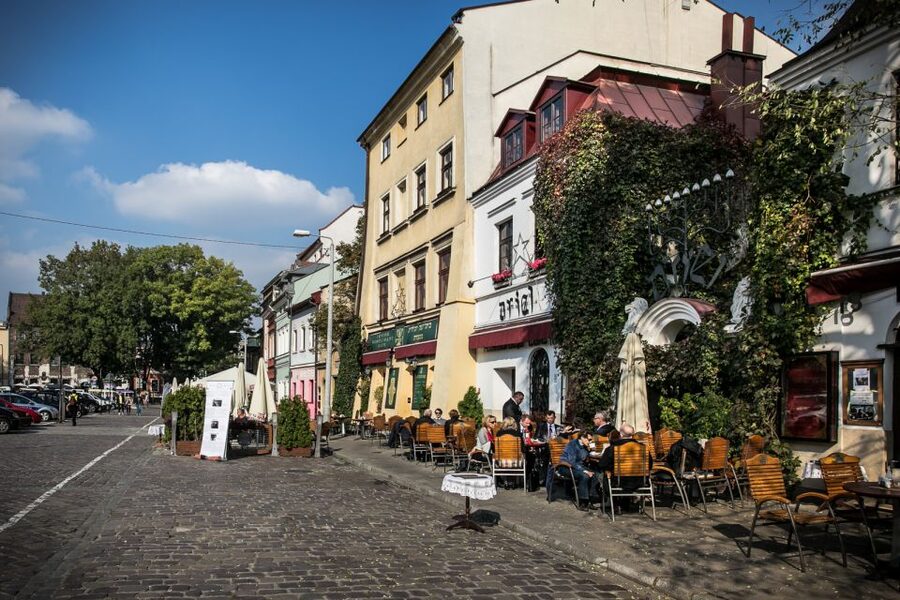
Kazimierz is the emotional center of the experience. Here the guide explains why Jewish communities settled in the area, how Jewish and Catholic communities lived alongside one another, and how both communities changed over time.
The route includes Tempel Synagogue, the Old Synagogue, the old Jewish cemetery, New Square, the medieval square of the Jewish quarter, and the walls of the Jewish quarter. It also includes memorials to Holocaust victims, the Righteous Among the Nations, and Polish victims during the occupation.
That list shows the range of the neighborhood. You are not seeing only synagogues or only wartime memorials. You are tracing community life, religious practice, urban space, persecution, and remembrance.
The Old Synagogue and Tempel Synagogue represent different parts of Jewish life in Kazimierz. The cemetery adds another layer, while New Square helps you understand the district as a lived neighborhood rather than a collection of monuments.
The Holocaust memorials require a measured approach. The route deals with one of the most painful and controversial parts of the city’s past, and the guide’s role is important here. A clear explanation can help you understand both the scale of the loss and the way Kraków remembers it.
Kazimierz also rewards careful observation. Look at the spaces between the formal sights: the squares, walls, streets, and transitions between religious buildings. The value of a local-style tour is often found in these connections, not only at the named stops.
How much history fits into three hours
The tour promises a great deal: medieval Kraków, Polish political and religious history, university life, Wawel, Jewish settlement, Catholic and Jewish coexistence, the Holocaust, and occupation memorials.
That breadth is both its strength and its limitation. You receive a clear first map of Kraków’s story, but you will not become an expert on every building. The pace was praised for moving well between places, and that matters when covering two districts. Still, you should expect a brisk introduction rather than long periods for photography or private reflection.
One useful sign is the teaching method. Explanations supported by maps, photos, and drawings can make a quick stop more meaningful. You may see a medieval wall, then understand how the city once worked. You may stand at a memorial, then connect it to the community that lived in Kazimierz before the occupation.
The route is especially helpful at the start of a Kraków visit. Take notes on places you want to revisit, then return later for a museum, interior visit, or slower look.
Price, timing, and practical value
At $16 per person, this is an inexpensive way to spend three hours with a trained guide. The value comes from the amount of ground covered and the historical interpretation, not from included extras. Food and drinks are not included.
The experience has free cancellation up to 24 hours before the start, and you can reserve now while paying later. Check the available starting times when booking, since the exact schedule is not fixed in the information provided.
The live guide speaks Spanish. That makes this a clear choice for Spanish-speaking visitors who want more than a basic audio explanation. It is also wheelchair accessible, though the hill, historic streets, and long route are worth considering when judging your own comfort.
Weather deserves attention. One December departure continued through cold and snow, so bring suitable outdoor clothing if you book in winter. You will spend the full three hours outside or moving between outdoor landmarks, and a gray umbrella identifies the guide at the meeting point.
Who should book this Kraków walk
I would choose this tour if you want a Spanish-language introduction to Kraków that combines the main center with Kazimierz. It suits first-time visitors, history students, and anyone who prefers a guide who explains cause and effect rather than reciting dates.
It is also a good fit if you have only a short stay. You can cover the city’s most important historic zones in one outing, then decide where to spend more time later.
I would not choose it as your only Wawel experience if you want detailed interior visits. Nor is it ideal if you prefer a slow photographic walk with long breaks. The route is ambitious, and the three-hour schedule keeps it moving.
Should you book it?
Book this tour if you want Kraków explained in Spanish, with the Old Town, Wawel, and Kazimierz tied into one historical story. The strongest features are the guide’s teaching style, the broad route, and the serious treatment of Jewish Kraków and wartime memory.
At $16, it offers strong value for a structured first look. Just arrive ready to walk, dress for the weather, and accept that the route is an introduction rather than a detailed visit to every site. If Luis is leading your departure, expect clear explanations, visual aids, and an enthusiastic approach to Kraków’s past.
FAQ
How long does the Kraków Old Town and Jewish Quarter tour last?
The tour lasts three hours.
What language is the tour offered in?
The live tour guide speaks Spanish.
Who guides the experience?
The guide is a graduate in Geography and History. Luis is named as a guide for this experience.
What areas of Kraków does the route visit?
The route covers the historic city center, the university neighborhood, Wawel, and Kazimierz, the Jewish quarter.
Is Wawel included?
Yes. The route visits the Wawel complex, including the cathedral, the hill, its associated buildings, and the dragon sculpture.
Which Jewish Quarter sights are included?
The route includes Tempel Synagogue, the Old Synagogue, the old Jewish cemetery, New Square, the medieval square of the Jewish quarter, the district walls, and several occupation and Holocaust memorials.
Is food or drink included?
No. Food and drinks are not included.
Is the tour wheelchair accessible?
Yes, the activity is listed as wheelchair accessible.
Just added around Krakow
- From Krakow: Zakopane Full-Day Tour with Lunch Option★ 4.4 · 62 reviews
- From Krakow: Zalipie and Painted Village Guided Tour★ 4.0 · 4 reviews
- From Krakow: Zakopane and Dunajec River Rafting Tour★ 4.6 · 31 reviews
- From Krakow: Zakopane and the Tatra Mountains★ 4.7 · 36 reviews
- From Krakow: Zakopane and Gubałówka Cable Car Private Tour★ 4.3 · 12 reviews
- From Krakow: Zakopane Tatra Mountains & Hot Springs Tour★ 3.0 · 29 reviews
- Zakopane & Tatra Mountains Private Full-Day Tour from Krakow★ 4.5 · 33 reviews
- From Krakow: Hot Springs and Zakopane with Gubałówka★ 4.7 · 25 reviews
Krakow Jewish Quarter Tours, compared.
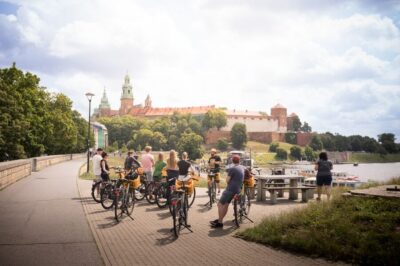
Bike Tour of Old Town, Jewish Quarter and the Ghetto
Read our review →
Kazimierz, Schindler’s Factory & Ghetto Guided Tour
Read our review →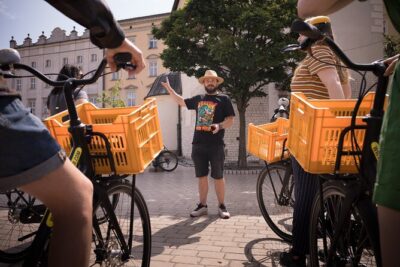
Full Bike Tour – the Old Town, Jewish Qtr & the Ghetto NEW BIKES
Read our review →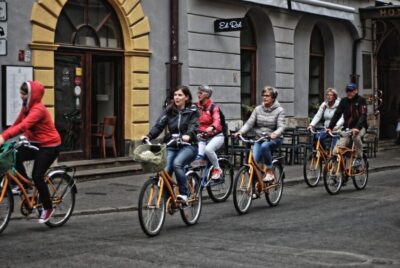
Bike Tour of the Old Town, Kazimierz, and the Ghetto
Read our review →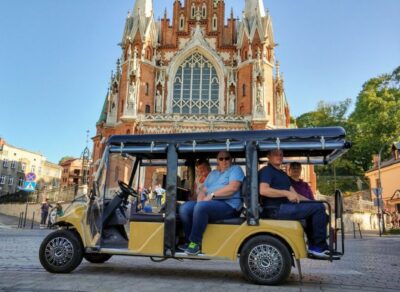
Jewish Quarter and Ghetto Electric Golf Cart Tour
Read our review →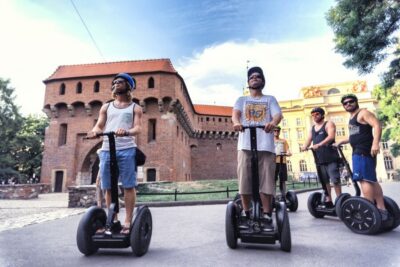
Browse the lists this tour appears in