
Reviewed · KRAKOW JEWISH GHETTO TOURS
Krakow: Old Town – Kazimierz – Ghetto by Electric Golf Cart
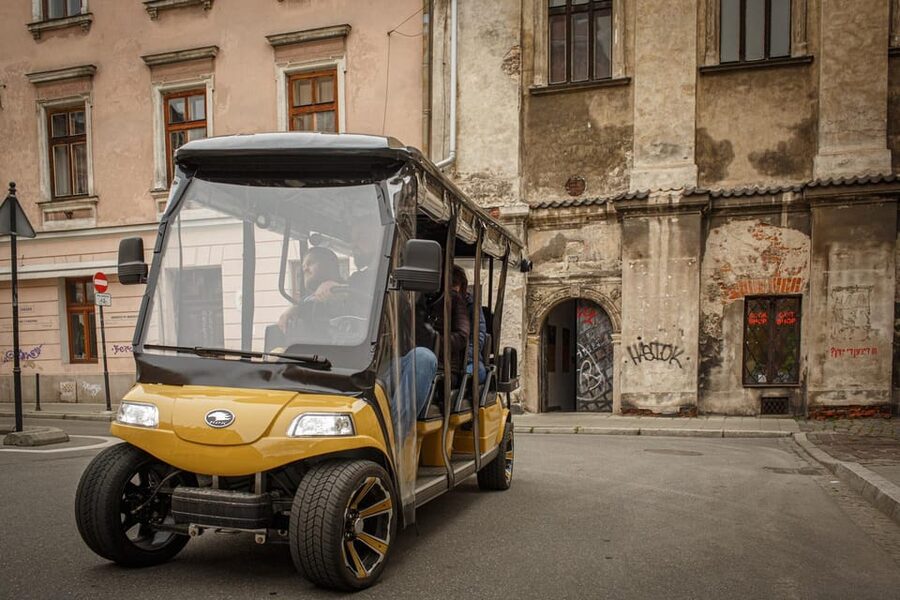
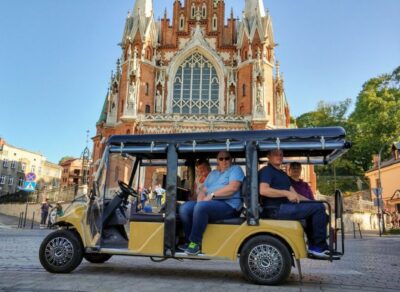
Krakow’s three most important historic districts fit into one useful ride here: the Old Town, Kazimierz, and Podgórze, the former ghetto area. Instead of spending your first day guessing which streets matter, you get a broad introduction from an electric golf cart, with live guidance and an audio system filling in the details.
I like the way this tour links famous sights with less obvious corners, from the Planty gardens and Barbican to old Jewish shops, synagogue streets, the ghetto wall, and the Pharmacy under the Eagle. I also like the practical 150-minute format, which gives you a citywide orientation without asking you to walk the full route.
The main drawback is the pace. You see many places from the vehicle, but you will not have time to explore every church, synagogue, or museum properly. The tour is best for getting your bearings, not replacing focused visits to Wawel, Schindler’s Factory, or Kazimierz.
Key points to know before booking
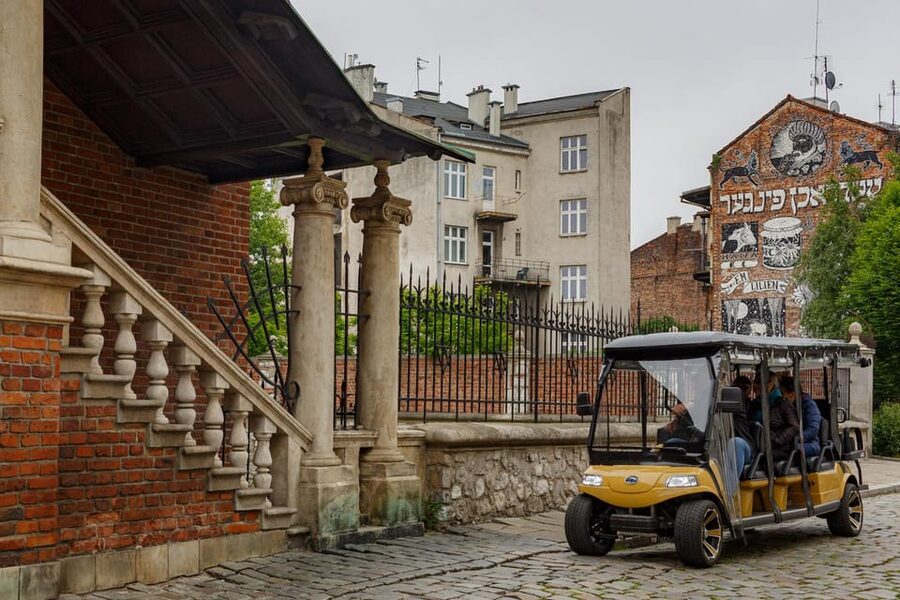
- Three districts in one ride: Cover Krakow’s Old Town, Kazimierz, and former ghetto area in 150 minutes.
- A useful first-day overview: See where you want to return for longer visits later.
- Strong guide feedback: Radar, Natalie, and another young male guide are praised for clear, capable explanations.
- History with visual context: The route connects medieval city defenses, Jewish Krakow, Nazi occupation, and postwar memory.
- English or Polish service: Drivers speak Polish or English, with an audio guide system included.
- Practical limits: Bags, alcohol, bikes, non-folding wheelchairs, and electric wheelchairs are not allowed in the vehicle.
Why an electric golf cart works well in Krakow
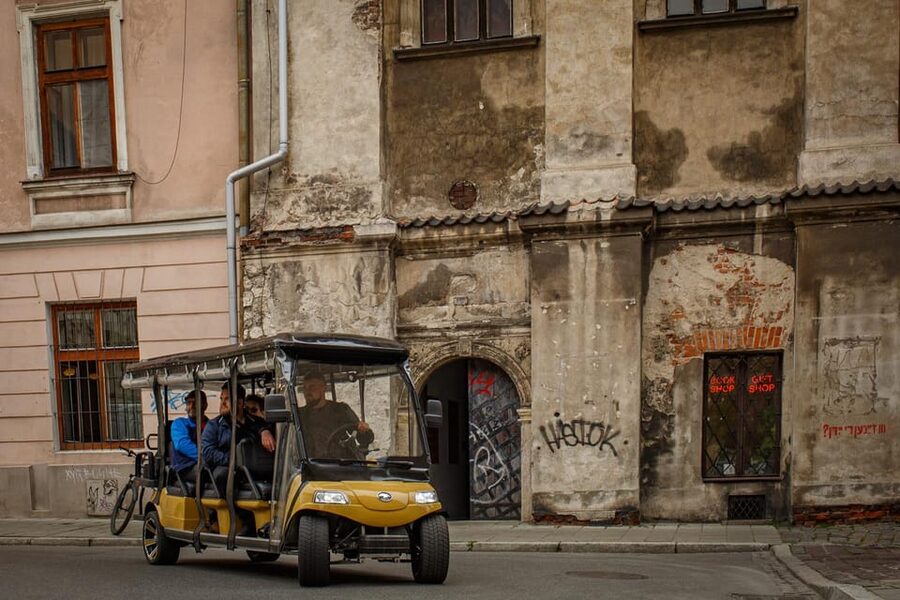
Krakow is compact on a map, but its key historic areas are spread across different parts of the city. The Old Town sits inside the former defensive walls. Kazimierz lies south of the center, and Podgórze is across the Vistula River. A golf cart lets you connect these areas without turning the day into a long march.
I find this especially useful at the start of a short Krakow visit. You can see the shape of the city, note the streets that catch your eye, and then return on foot. The vehicle also keeps the route moving in poor weather, though you should still bring water and dress for the season.
This is a sightseeing ride rather than a hop-on, hop-off service. The itinerary lists a large number of landmarks, but the tour lasts 150 minutes. Expect passing views, short explanations, and a few moments when the guide points out an important building or street. Do not expect a long stop at every location.
The electric vehicle is also a practical choice for travelers who want less walking, but the restrictions matter. Non-folding and electric wheelchairs are not allowed, and the vehicle cannot take bikes or bags. The supplied information also lists many age restrictions, including children under 16 and people over 60, with several overlapping limits. Check the current eligibility rules carefully before paying.
More Jewish Ghetto tours in Krakow:
- Krakow: Schindler’s Factory & Ghetto Guided Tour
★ 4.7 · 1,694 reviews - Krakow: Jewish Quarter and Former Ghetto Tour
★ 4.9 · 1,441 reviews - Krakow: Bike Tour of Old Town, Jewish Quarter and the Ghetto
★ 4.9 · 1,155 reviews
Starting among Krakow’s medieval defenses
The meeting point is at the Kiss&Ride parking area opposite a Żabka store. That landmark matters because a city street can offer plenty of similar-looking corners, so look for the parking area rather than simply heading toward the Old Town.
The opening section introduces Krakow and follows the Planty, the green belt that circles the historic center where the medieval walls once stood. You then pass the Church of St. Cross, the Słowacki Theater, the former city walls, and the Barbican.
The Barbican is one of the most recognizable remnants of Krakow’s defenses. From the cart, you get the setting and the basic purpose of the fortifications. Jan Matejko Square, the Church of St. Florian, and Sławkowska Street add more layers to the north side of the center.
This part works well as a visual primer. You begin to understand how the old city was enclosed, where people entered, and how the modern streets relate to the medieval core. The limitation is simple: if defensive architecture is your main interest, you will want to return on foot for a closer look.
Through the Old Town to the Main Square
The route continues past the Czartoryski Museum, St. John’s Street and Church, and into the Main Square. The square is Krakow’s central reference point, so seeing it during the ride helps you place many later stops on a mental map.
You also pass Plac Szczepański, the Palace of Art, St. Anne’s Church, the Town Hall, the Franciscan Church, and Wawel Castle. Each gives the guide another chance to explain how Krakow’s religious, civic, artistic, and royal stories overlap.
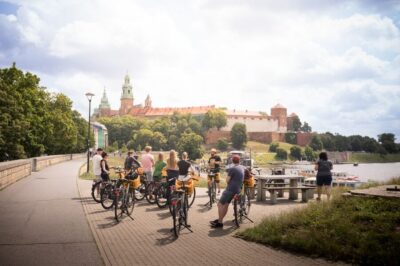
Wawel is one of the major visual rewards of the route. The castle complex sits above the river and carries enormous importance in Polish history. This tour gives you the wider setting and a useful introduction, but it does not include a listed castle admission. If you want the cathedral, royal chambers, or museum collections, plan a separate visit.
The same applies to the Czartoryski Museum. The cart can show you where it is, but the experience does not list an entry ticket. Use this first pass to decide which interiors deserve your time.
Kazimierz, Krakow’s former Jewish district
After the Old Town, the ride turns toward Kazimierz. The guide provides an introduction to the Jewish district before taking you through some of its most important streets and religious sites.
You pass Skałka Church, St. Catherine’s Church, and Wolnica Square, once the center of the medieval Jewish city. The square is a useful stop in the story because Kazimierz was not simply a neighborhood beside Krakow. It developed as a separate town before becoming part of the larger city.
The route then includes the Church of Corpus Christi, Tempel Synagogue, Kupa Synagogue, Isaac Synagogue, Ciemna Street, the Old Synagogue, and Popper Synagogue. You also see the former family home of Helena Rubinstein, the cosmetics pioneer whose early life was connected with Krakow’s Jewish community.
This section is valuable because it shows Kazimierz as a lived-in district, not only a collection of photogenic buildings. Streets, places of worship, shops, and squares all help explain how the area functioned.
Still, the cart cannot offer the full experience of the synagogues or Jewish museum interiors. The route gives you names and locations, while a later walking visit can give you more time for architecture, exhibits, and reflection. If you plan to enter any synagogue, confirm opening hours separately.
More Kazimierz and Jewish Quarter tours in Krakow:
- Krakow: Kazimierz Jewish Quarter Walking Tour
★ 4.8 · 571 reviews - Krakow: Kazimierz, Schindler’s Factory & Ghetto Guided Tour
★ 4.8 · 460 reviews - Full Bike Tour – the Old Town, Jewish Qtr & the Ghetto NEW BIKES
★ 5.0 · 437 reviews - Krakow: Bike Tour of the Old Town, Kazimierz, and the Ghetto
★ 4.9 · 350 reviews
Synagogues and the old cemetery
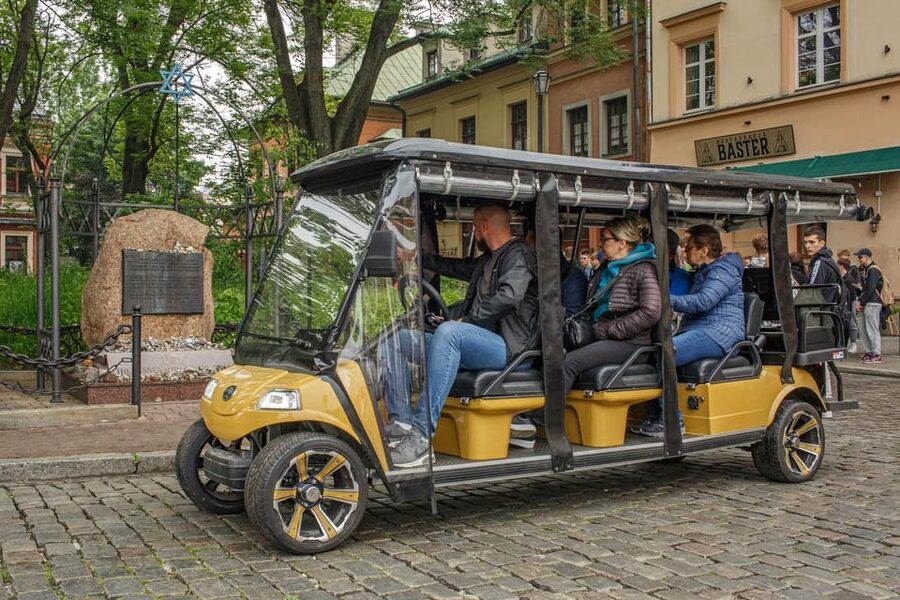
The most concentrated historical section comes around the Old Synagogue, Remuh Synagogue, and the old cemetery. The Remuh site is particularly important because it brings religious life, community memory, and burial traditions into one place.
The route also includes old Jewish shops and a memorial stone connected with the Nissembaum Family Foundation. These details help move the story beyond famous buildings. You get reminders of ordinary trade, family life, and the community that once filled these streets.
This is where an audio guide can be useful. With so many names in a short period, it is easy to lose track of which synagogue belongs to which tradition or period. The live driver can keep the ride personal, while the audio system provides additional narration in the selected language.
You should expect the information to come in a steady stream. If you prefer slow photography or long pauses, this part may feel rushed. If you want a clear introduction before returning independently, the pace is more helpful.
Across the river to Podgórze and the former ghetto
The final district is Podgórze, the former ghetto area. The tone changes here. The route moves from medieval Krakow and Jewish community life to Nazi persecution, forced relocation, and the destruction of the city’s Jewish population.
You see Ghetto Heroes Square, the Pharmacy under the Eagle, and the former residence of Tadeusz Pankiewicz. The pharmacy is closely tied to the history of the ghetto and to Pankiewicz, who operated there during the occupation. It is now an important place for understanding daily life under brutal conditions.
The tour also explains Oskar Schindler’s connection with Krakow. Schindler’s story is widely known, but this route places it within the physical setting of the city rather than treating it as an isolated film location. You see how the former ghetto, nearby workplaces, and surrounding streets fit together.
Ghetto Heroes Square is another place where the vehicle format has both value and limits. You can reach it without a long walk and hear the historical explanation in context. But the square deserves quiet attention, and you may want to return later if you prefer to spend more time there.
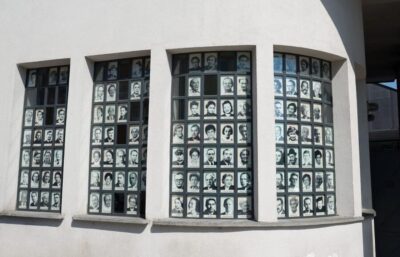
The route continues with an explanation of life in the ghetto, the surviving section of the ghetto wall, and St. Joseph’s Church. The wall is a stark reminder that the ghetto was a controlled and enclosed space, not simply a neighborhood with an unfortunate name.
This part calls for a respectful attitude. The route covers painful history, and the benefit of having a guide is that the places are connected into a clear account rather than treated as quick photo stops.
What the guide and audio system add
The experience includes a live tour guide, an electric vehicle, and an audio guide. Drivers speak Polish or English. The combination should suit you if you want human direction but also appreciate extra narration while moving between stops.
The strongest praise attached to the experience centers on the guides. Radar is described as a particularly good guide, and Natalie is praised for being kind, helpful, and very capable. Another booking describes the young male guide as exceptionally well informed. Those comments suggest that guide quality can make a real difference here, especially because the route covers so much history in limited time.
You should still check the language you select when booking. The advertised driver languages are Polish and English, while the audio guide system is intended to support the city tour in your chosen language. The exact language menu is not specified beyond Polish and English.
The group format can also be part of the appeal. You ride with other people rather than arranging a private vehicle, which keeps the price lower and can make the tour feel social. On the other hand, group timing means you will not control every pause or change the route for a personal interest.
Is $41 a fair price for 150 minutes?
At $41 per person, the tour costs about $16.40 per hour. That is reasonable if you value the vehicle, live driver, audio system, and the chance to cover three districts without arranging separate transport.
The value is strongest for a first visit, a short stay, or a day when a long walking route does not appeal. You are paying for orientation and transport as much as for individual sights. The tour also helps you choose where to spend your own time later.
The price is less attractive if you want entry to major attractions. No museum, synagogue, or castle admission is listed among the included features. You should budget separately for places such as Wawel, the Czartoryski Museum, the Pharmacy under the Eagle, or synagogue interiors if you plan to go inside.
Free cancellation up to 24 hours before departure and reserve-now, pay-later booking reduce the risk of fitting the ride into a changing Krakow schedule. Starting times depend on availability, so check the exact departure when you book.
Who should book this Krakow city tour?
I would choose this for a first-time visitor who wants a quick but serious introduction to Krakow. It suits you if you want to understand the relationship between the Old Town, Kazimierz, and Podgórze before returning to selected areas on foot.
It is also a good fit if you enjoy history but do not want to spend your first hours studying a map. The route covers medieval defenses, royal Krakow, Jewish community life, Nazi occupation, the ghetto, and Schindler’s story in one connected outing.
You may want a different experience if your priority is photography, museum time, or synagogue interiors. The large number of listed sights means the commentary must move quickly. This is a city overview with historical explanation, not a series of long guided visits.
Bring water. Do not bring bags, alcohol, bikes, or prohibited mobility equipment. Smoking is not allowed in the vehicle. The age and mobility rules are unusually broad and somewhat overlapping, so confirm that every member of your party qualifies before booking.
My verdict: book it for orientation, not deep sightseeing
I recommend this ride if you have limited time in Krakow or want a clear first look at the city’s major historic districts. The route is unusually wide-ranging, and the transition from the Planty and Barbican to Kazimierz and the former ghetto gives you a strong sense of how Krakow’s past is arranged on the ground.
Book it with the right expectations. You will see many landmarks, hear useful explanations, and identify places worth revisiting. You will not have enough time to fully explore each church, synagogue, museum, or memorial. For $41, that broad orientation is fair value, especially when the guide is as strong as Radar, Natalie, or the praised young male guide.
FAQ
How long does the electric golf cart tour last?
The tour lasts 150 minutes, or two and a half hours.
Which parts of Krakow does the route visit?
It visits the Old Town, Kazimierz, the Jewish district, and Podgórze, the former ghetto area.
Is a guide included?
Yes. The experience includes a live tour guide, an electric vehicle, and an audio guide system.
Which languages are available?
The drivers speak Polish and English. The activity also includes an audio guide system.
Where is the meeting point?
Meet at the Kiss&Ride parking area opposite the Żabka store.
Is the tour suitable for wheelchair users?
Non-folding wheelchairs and electric wheelchairs are not allowed in the vehicle. Check the current accessibility rules before booking.
Can I cancel for a full refund?
Yes. You can cancel up to 24 hours in advance for a full refund. You can also reserve now and pay later.
More electric golf cart tours in Krakow
- Krakow: City Sightseeing Tour by Electric Golf Cart
★ 4.5 · 3,264 reviews - Krakow: City Sightseeing Tour Eco Electric Buggy Golf Cart
★ 4.7 · 3,143 reviews - Krakow: Extended City Sightseeing Tour – Eco Buggy Golf Cart
★ 4.7 · 794 reviews - Krakow: Electric Car Sightseeing Tour
★ 4.4 · 450 reviews
More Old Town walking tours in Krakow
- Old Town Krakow & Wawel Castle Walking Tour
★ 5.0 · 1,508 reviews - Krakow: The Old Town Walking Tour
★ 4.8 · 794 reviews - Krakow: Old Town Guided Segway Tour
★ 4.7 · 756 reviews - Kraków: Old Town & Wawel Castle Walking Tour in English
★ 4.8 · 532 reviews
Just added around Krakow
- From Krakow: Zakopane Full-Day Tour with Lunch Option★ 4.4 · 62 reviews
- From Krakow: Zalipie and Painted Village Guided Tour★ 4.0 · 4 reviews
- From Krakow: Zakopane and Dunajec River Rafting Tour★ 4.6 · 31 reviews
- From Krakow: Zakopane and the Tatra Mountains★ 4.7 · 36 reviews
- From Krakow: Zakopane and Gubałówka Cable Car Private Tour★ 4.3 · 12 reviews
- From Krakow: Zakopane Tatra Mountains & Hot Springs Tour★ 3.0 · 29 reviews
- Zakopane & Tatra Mountains Private Full-Day Tour from Krakow★ 4.5 · 33 reviews
- From Krakow: Hot Springs and Zakopane with Gubałówka★ 4.7 · 25 reviews
Krakow Jewish Ghetto Tours, compared.
Bike Tour of Old Town, Jewish Quarter and the Ghetto
Read our review →
Kazimierz, Schindler’s Factory & Ghetto Guided Tour
Read our review →
Full Bike Tour – the Old Town, Jewish Qtr & the Ghetto NEW BIKES
Read our review →
Bike Tour of the Old Town, Kazimierz, and the Ghetto
Read our review →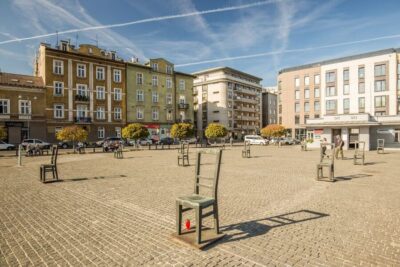
Jewish Quarter and Ghetto Electric Golf Cart Tour
Read our review →Browse the lists this tour appears in