
Reviewed · KRAKOW JEWISH GHETTO TOURS
Krakow: Jewish Ghetto Walking Tour
The most powerful part of this Kraków tour is that it takes place in ordinary streets. Cars pass, people shop, and daily life continues around the former ghetto, yet the surviving wall and the empty chairs at Ghetto Heroes Square make the past impossible to ignore. You walk through the actual setting rather than hearing about it from a distant museum room.
I like the one-hour length, which gives you a serious introduction without taking half your day. I also like the use of old photographs, reported by several guests, to show how the streets once looked. The main drawback is that an hour can feel rushed, especially when you have a guide such as Anna, whose store of historical detail could easily fill several more hours.
Key points before you book
- See the original Ghetto Wall: One of the few surviving fragments of the barrier that enclosed more than 15,000 people.
- Pause at Ghetto Heroes Square: The metal chairs recall those deported from the square during the Holocaust.
- Hear about Tadeusz Pankiewicz: Learn how the pharmacist and his staff helped people inside the ghetto.
- Walk through real wartime streets: The layout and some buildings remain, even though much of the original district has changed.
- Choose from nine languages: Tours are offered in English, French, German, Italian, Spanish, Russian, Portuguese, Swedish, and Slovak.
- Pay about $11: That is a strong price for a guided introduction, particularly if you want context you would miss on your own.
Why Podgórze matters to your Kraków visit
The former Kraków Ghetto lies in Podgórze, across the river from the city’s historic center. During World War II, Nazi authorities forced Jewish residents into a confined area surrounded by walls. More than 15,000 people were packed into only a few city blocks.
That fact becomes easier to grasp when you walk the streets. You are not simply looking at a plaque or a preserved room. You are seeing the distances between buildings, the narrow public spaces, and the streets where people were forced to live under Nazi rule.
The tour focuses on daily life as well as the larger events. Your guide explains how people tried to find food, medicine, shelter, and some measure of safety. You also hear about deportations and the terrible fate awaiting many residents.
This local focus works well beside a visit to Auschwitz, but it is not a substitute for it. Auschwitz presents a larger camp system and its crimes. This walk shows what happened before that final stage, when families were confined, separated, threatened, and eventually removed from their homes.
More Jewish Ghetto tours in Krakow:
- Krakow: Schindler’s Factory & Ghetto Guided Tour
★ 4.7 · 1,694 reviews - Krakow: Jewish Quarter and Former Ghetto Tour
★ 4.9 · 1,441 reviews - Krakow: Bike Tour of Old Town, Jewish Quarter and the Ghetto
★ 4.9 · 1,155 reviews
Starting near Schindler’s Factory
Many departures begin near Schindler’s Factory, although the exact meeting point depends on the option you book. This is a useful place to begin because it connects the ghetto story with one of Kraków’s best-known wartime sites.
Do not assume that this walking tour includes entry to Schindler’s Factory. The advertised experience is a guided walk through the former ghetto. Some people combine the two activities, and one guide may refer to an earlier factory visit, but you should check your booking details carefully.
Arrive 10 minutes early. The group leaves on time, and latecomers cannot join or receive a refund. A meeting point outside the factory can be easy to find, with signs showing the company, language, and departure time. In cold weather, one guide invited the waiting group indoors, but you should still dress as if you will spend the full hour outside.
The walking route is described as relatively flat, though you will be on your feet for much of the hour. Wear comfortable shoes. The tour operates in rain or shine, so a waterproof layer in wet weather and warm clothing in winter are sensible choices.
Reading the remains of the Ghetto Wall
The Ghetto Wall is one of the clearest physical reminders on the route. Only fragments remain, but that is part of the lesson. You see enough to understand that this was not an abstract boundary. It was a barrier designed to control movement and isolate the people inside.
At the wall, the guide puts the surviving section into context. You learn how the ghetto enclosed more than 15,000 people in a very small area, and how restrictions shaped every part of daily life.
This is where a guide adds real value. On your own, you might take a photograph and move on. With a guide, the stones become evidence of the system that operated around them. You can also compare the present-day street with older photographs. Phil was praised for carrying photographs that helped the group picture the area as it once appeared, and this is exactly the sort of detail that makes the walk easier to follow.
Do not expect a large preserved complex. Much of the old district has changed, and only selected buildings, walls, and street patterns remain. If you want intact interiors at every stop, this is not that kind of tour. Its strength lies in connecting small surviving details to the wider story.
Ghetto Heroes Square and the empty chairs
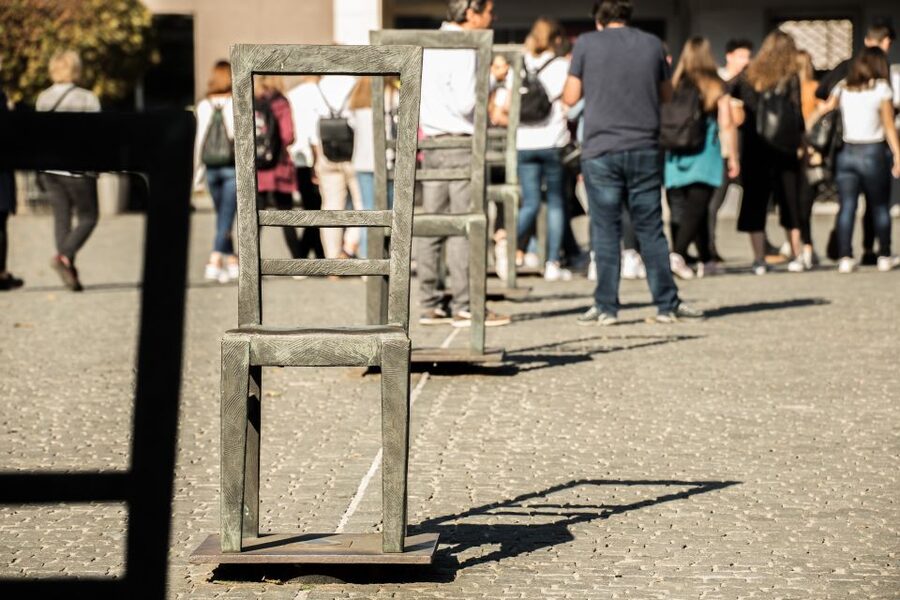
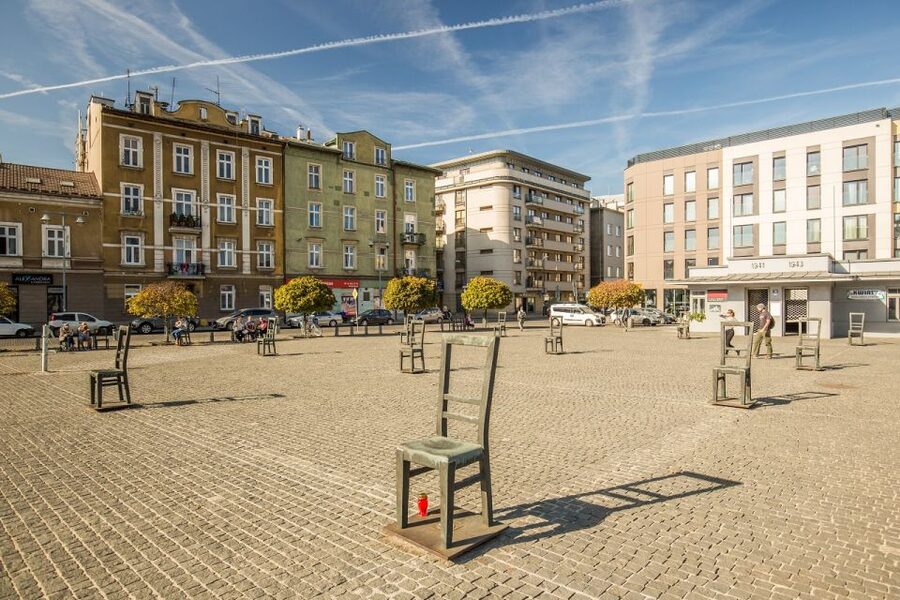
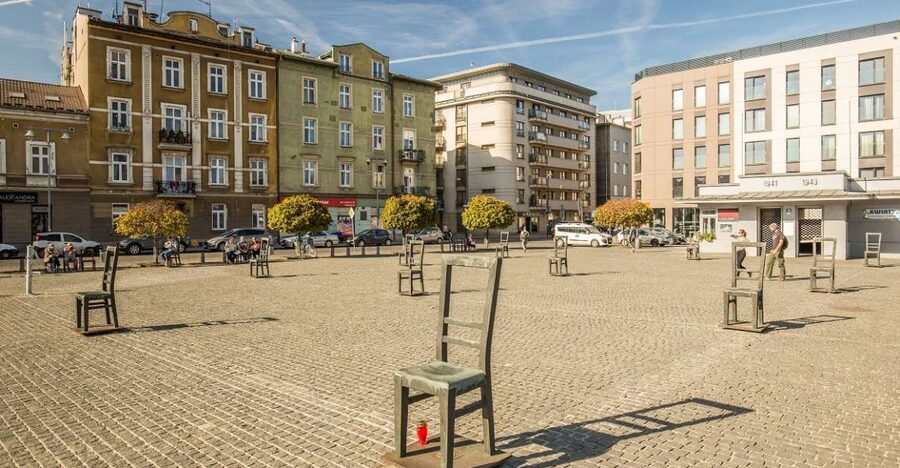
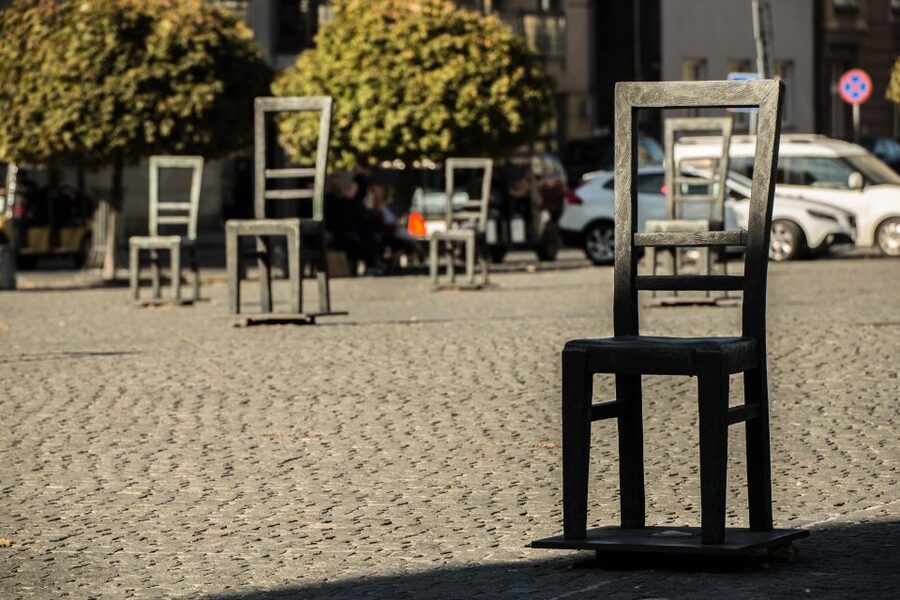
The route continues to Ghetto Heroes Square, the emotional center of the walk. During the occupation, the square was linked to deportations to concentration camps. Today, rows of empty metal chairs fill the space.
The chairs are a simple but forceful memorial. They suggest people who were taken away, homes left behind, and possessions abandoned. Their open spaces also make you think about absence. There is no large monument blocking the view. The square remains part of the modern city, which makes the historical use of the place feel close rather than sealed away.
Your guide explains what happened here and helps connect the memorial to the people who lived in the ghetto. The best guides keep the focus on individuals rather than turning the tour into a list of dates. Joanna, Helen, Ewa, and Aga were all singled out for compassionate storytelling and clear explanations.
This stop can be difficult. The subject is deportation and mass murder, and the tour does not soften that reality. I would not choose it as a light activity between shopping stops. Give yourself a little quiet time afterward, particularly if you have also visited Auschwitz.
More Old Town walking tours in Krakow:
- Old Town Krakow & Wawel Castle Walking Tour
★ 5.0 · 1,508 reviews - Creepy Krakow: 2-Hour City Walking Tour
★ 4.7 · 1,131 reviews - Krakow: The Old Town Walking Tour
★ 4.8 · 794 reviews - Krakow: Kazimierz Jewish Quarter Walking Tour
★ 4.8 · 571 reviews
Under the Eagle Pharmacy and stories of courage
Across the square is Under the Eagle Pharmacy, linked to pharmacist Tadeusz Pankiewicz. He and his staff risked their lives to help people in the ghetto, offering medicine and shelter.
The pharmacy gives the tour a human scale. The ghetto story includes immense suffering, but it also includes choices made by people who tried to help despite the danger. Your guide explains the role of Pankiewicz and his staff, adding a story of practical courage to the broader account of occupation and deportation.
One important detail: the pharmacy may not be open during your visit. A guest found it closed, even though the outside and its place in the route remained useful. The walking tour includes the location and its history, but you should not assume that museum entry is included or guaranteed.
If you want to see the interior, check the opening details separately before booking. Even without entry, the stop still works because the guide explains why this particular pharmacy mattered.
Original buildings and an ordinary city around them
The walk also points out authentic wartime buildings and sections of the original street layout. These may not look dramatic at first. A doorway, a building line, or a familiar street can seem unremarkable until you learn what happened there.
That contrast is one of the tour’s strongest features. The former ghetto is not presented as a perfectly preserved historical set. It is a living district, and modern life continues beside places marked by fear, confinement, and loss.
Several people appreciated that the guide kept talking while the group moved between stops. The route is not a series of long speeches followed by silent walks. You receive context as you go, with pauses at the wall, the square, the pharmacy, and other notable locations.
The pace appears steady rather than strenuous. One guide was praised for making it easy for slower walkers to keep up, while another visitor felt there was a lot of walking for the short duration. Both points can be true. The distance may not be extreme, but you should expect to walk for most of the hour and listen outdoors.
The guides make the difference
The tour is offered with live guides in nine languages, and the quality of the experience depends heavily on who leads your group. Names praised in the feedback include Olga, Joanna, Helen, Ewa, Aga, Phil, Kris, Krzysztof, and Fil.
The most common strength is clear, personal storytelling. Guides explain the facts, answer questions, and describe what life may have felt like for people trapped inside the ghetto. Some use photographs. Others connect the wartime story to the moral questions it raises today.
Aga was described as linking the occupation to current events while stressing the need to learn from the past. Ewa was noted for speaking about suffering with care and respect. Phil was appreciated for involving the group and adding photographs. These details suggest that the tour is not intended as a dry recital.
There are a few practical limits. Group tours operate in one language only, so select your preferred language when booking. One person found it hard to hear and wished for stronger amplification and a slower speaking pace. Other departures supplied headsets or ear microphones, which helped people follow the guide near busy streets, but equipment may vary by option.
If you prefer a quieter, more private experience, a private group is available. It should give you more freedom to ask questions, though the supplied information does not specify the extra price or exact format.
Is one hour enough?
For a first look, yes. The one-hour format is short enough to fit around a museum visit, a meal, or a larger Kraków itinerary. It is also long enough to reach the main sites and explain the basic story.
Still, one hour forces choices. A guide cannot fully explain the history of the ghetto, Nazi occupation, Polish responses, Jewish community life, deportations, and individual stories in great depth during such a short route.
That limitation is especially clear when you have a guide with a large amount of historical material. One visitor felt Anna could have spoken for three more hours. Another called the tour short but worthwhile. I read this as a sign that the experience works best as an introduction, not a complete study of Kraków during the war.
If you have already visited the district alone, the guide can supply the missing context. If you have a full day available and want detailed museum time, pair the walk with Schindler’s Factory or Under the Eagle Pharmacy if open. Check separately for admission because food, drink, and museum entry are not included in the tour price.
The $11 price and overall value
At about $11 per person, this is inexpensive for a live guided walk in a major European city. The price is particularly fair because the subject requires context. The physical remains are limited, so the guide’s explanation is what turns a few walls, streets, and chairs into a meaningful visit.
The value is less about the number of sights and more about what you learn at each one. Without a guide, you could see the wall and the chairs but miss the connection between the sites, the ghetto’s size, the deportations, and the acts of help around the pharmacy.
The trade-off is that this is a group walking tour, and the meeting point may vary. You also need to arrive early and accept the risk that bad weather can make the hour less comfortable. Free cancellation up to 24 hours ahead and reserve-now, pay-later booking make it easier to fit into a changing Kraków schedule.
The overall rating is 4.6 from 349 reviews, with especially strong praise for guide enthusiasm, historical detail, sensitivity, and value. A smaller number of lower ratings focused on the short duration, occasional difficulty hearing, the pharmacy being closed, or uncertainty about the ending point.
Who should book this Kraków Ghetto walk?
I recommend it if you want to understand how people lived inside the ghetto, not only where the Holocaust later reached its final stages. It suits first-time visitors, history-minded travelers, and anyone who prefers learning through real streets and places.
It is also a good choice after Schindler’s Factory. The two experiences can complement each other, though you should confirm that you are not booking duplicate activities. Families with older children may find the hour manageable, but the subject is severe and requires thoughtful preparation.
You might skip it if you want a light sightseeing walk, dislike emotionally difficult history, or need a fully preserved historic district. The route contains surviving fragments rather than a complete old neighborhood.
Should you book it?
Book this tour if you want a concise, serious introduction to Podgórze and the Kraków Ghetto at a very low price. The empty chairs, surviving wall, and Under the Eagle Pharmacy are meaningful stops, but the guide is the main reason to go.
Choose a language you can follow easily, arrive early, wear suitable shoes, and allow for rain or cold. If you want extensive detail, book a private option or add a museum visit. For most people, this one-hour walk is a useful and respectful way to understand a part of Kraków that is easy to pass without seeing.
FAQ
Where does the Kraków Jewish Ghetto walking tour take place?
The tour takes place in Podgórze, the district that contained the Kraków Ghetto during World War II. The exact meeting point can vary depending on the option booked.
How long does the tour last?
The walking tour lasts one hour. It includes the Ghetto Wall, Ghetto Heroes Square, Under the Eagle Pharmacy, and other wartime locations.
What languages are available?
Live guides are available in French, German, Italian, English, Spanish, Russian, Portuguese, Swedish, and Slovak. Group tours operate in one language, so select your preferred language when booking.
Is the tour private?
A private group option is available. Standard group tours are also offered.
What does the price include?
The price includes an expert guide and the guided walking tour of the Kraków Ghetto. Food and drink are not included.
Is entry to Under the Eagle Pharmacy included?
The tour visits the historic pharmacy and explains its role, but entry is not listed as included. The pharmacy may also be closed on the day of your visit.
What should I wear?
Wear comfortable footwear and clothing suitable for the forecast. The tour runs outdoors in all weather, including rain.
What happens if I arrive late?
You should arrive 10 minutes before departure. Once the group has left, latecomers cannot join and the ticket cannot be refunded.
Just added around Krakow
- From Krakow: Zakopane Full-Day Tour with Lunch Option★ 4.4 · 62 reviews
- From Krakow: Zalipie and Painted Village Guided Tour★ 4.0 · 4 reviews
- From Krakow: Zakopane and Dunajec River Rafting Tour★ 4.6 · 31 reviews
- From Krakow: Zakopane and the Tatra Mountains★ 4.7 · 36 reviews
- From Krakow: Zakopane and Gubałówka Cable Car Private Tour★ 4.3 · 12 reviews
- From Krakow: Zakopane Tatra Mountains & Hot Springs Tour★ 3.0 · 29 reviews
- Zakopane & Tatra Mountains Private Full-Day Tour from Krakow★ 4.5 · 33 reviews
- From Krakow: Hot Springs and Zakopane with Gubałówka★ 4.7 · 25 reviews
Krakow Jewish Ghetto Tours, compared.
Bike Tour of Old Town, Jewish Quarter and the Ghetto
Read our review →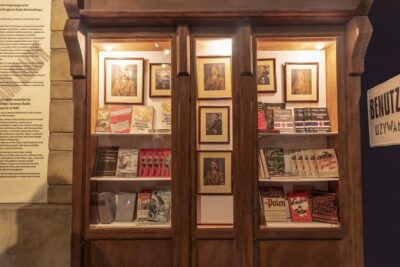
Kazimierz, Schindler’s Factory & Ghetto Guided Tour
Read our review →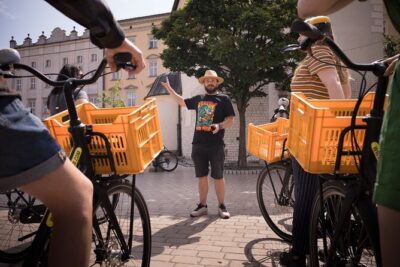
Full Bike Tour – the Old Town, Jewish Qtr & the Ghetto NEW BIKES
Read our review →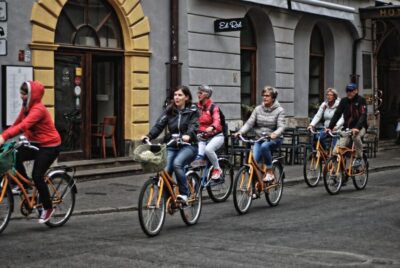
Bike Tour of the Old Town, Kazimierz, and the Ghetto
Read our review →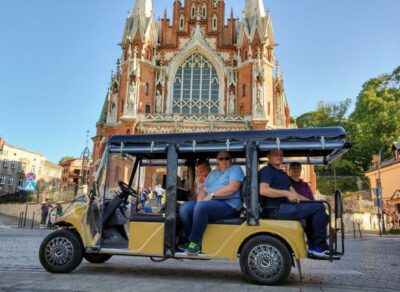
Jewish Quarter and Ghetto Electric Golf Cart Tour
Read our review →
Schindler’s Factory and Jewish Ghetto Guided Tour
Read our review →Browse the lists this tour appears in